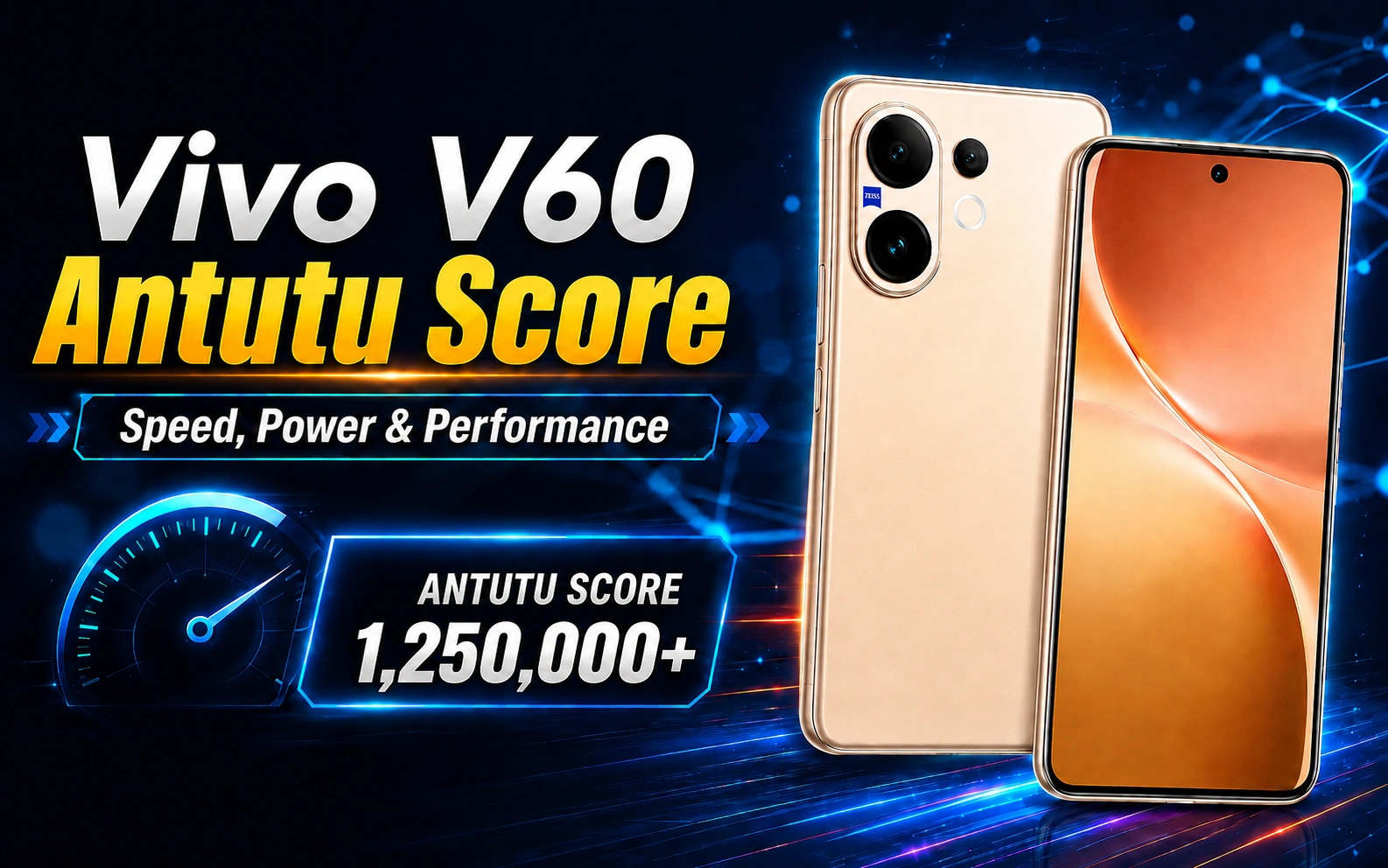
The Vivo V60 Antutu Score lands somewhere between roughly 1,000,000 and 1,260,000 points depending on which Antutu version and testing lab you look at, powered by its Snapdragon 7 Gen 4 chip — solid for daily use, but noticeably behind some rival mid-rangers running MediaTek’s Dimensity 8400-Ultra.
Disclaimer: Antutu scores are benchmark estimates, not guarantees of real-world performance, and can vary by 15–25% depending on the Antutu app version, RAM/storage variant, software update, and even room temperature during testing. The figures in this article are compiled from multiple independent benchmark-tracking sources and should be cross-checked against the latest Antutu app before making a purchase decision.
Vivo V60 — Quick Stats Table
| Spec | Detail |
|---|---|
| Launch | August 2025 |
| Chipset | Snapdragon 7 Gen 4 |
| Vivo V60 Antutu Score (avg. range) | ~1,006,885 – 1,261,932 (varies by version/source) |
| Display | 6.77-inch AMOLED, 120Hz |
| RAM | Up to 16GB (LPDDR4X) |
| Storage | Up to 512GB (UFS 2.2) |
| Battery | 6500mAh |
| Charging | 90W wired fast charging |
| Water/Dust Rating | IP68 / IP69 |
| Main Camera | 50MP OIS + 50MP 3x telephoto + 8MP ultra-wide |
| Build | Schott Xensation Core glass, glass or plastic back (by color) |
What Is The Vivo V60 Antutu Score, Anyway?
Think of Antutu like a full-body health checkup for your phone, it checks CPU muscle, GPU stamina, memory reflexes, and everyday smoothness. The Vivo V60 Antutu Score is simply the sum of four test categories, rolled into one big number that’s easy to compare across phones.
What Antutu Actually Tests
| Test Category | What It Measures | Why It Matters To You |
|---|---|---|
| CPU | Raw processing power for apps, multitasking | Faster app switching, quicker exports |
| GPU | Graphics rendering power | Gaming visuals, video editing smoothness |
| Memory (RAM) | Data read/write speed | How fast apps reopen from background |
| UX | Real-world responsiveness | Scrolling, touch response, app launch speed |
Vivo V60 Antutu Score: The Real Numbers
Here’s where it gets interesting — and a little messy. Different benchmark-tracking sites report different totals for the Vivo V60 Antutu Score, mainly because Antutu has multiple app versions (v10, v11) running at different times, and because Vivo’s own software updates can quietly shift performance.
| Source | Antutu Version | Reported Vivo V60 Antutu Score |
|---|---|---|
| Benchmark aggregator A | v10 | ~1,006,885 |
| Benchmark aggregator B | v10 | ~1,015,000 |
| Benchmark aggregator C | v11 (average) | ~1,261,932 |
Why The Vivo V60 Antutu Score Varies So Much
- Antutu version changes – v11 rewrote several sub-tests, so scores aren’t 1:1 comparable to v10.
- RAM variant differences – the 8GB, 12GB, and 16GB models don’t always post identical memory scores.
- Software updates – a system update can improve or throttle performance for thermal safety.
- Ambient temperature – benchmarking a phone in a warm room can shave off real points.
- Background apps running – yes, even that Antutu score can dip if fifteen apps are alive in the background.
Vivo V60 Antutu Score Breakdown By Category
If you want the “why” behind the total number, here’s the individual split most commonly reported:
| Category | Approx. Score | Share of Total |
|---|---|---|
| CPU | 312,069 – 479,143 | ~30–38% |
| GPU | 252,414 – 324,729 | ~25–26% |
| Memory | 175,817 – 201,306 | ~15–18% |
| UX | 194,270 – 343,281 | ~19–27% |
Vivo V60 Geekbench & Other Benchmark Scores
Antutu isn’t the only test in town. Geekbench focuses purely on CPU muscle without the graphics fluff, and it tells a cleaner, steadier story.
| Benchmark | Vivo V60 Score |
|---|---|
| Geekbench 6 Single-Core | ~1,244 – 1,247 |
| Geekbench 6 Multi-Core | ~3,557 – 3,585 |
| Geekbench GPU Compute | ~6,568 |
| 3DMark Steel Nomad Light | ~667 |
| PCMark 3.0 (real-world battery/work test) | ~11,318 |
Vivo V60 Antutu Score vs Rivals: Comparison Chart
This is the part most buyers actually care about — not “is 1 million good,” but “is 1 million good compared to what else I could buy at this price?” Vivo V60 Antutu Score trails the MediaTek Dimensity 8400-Ultra crowd by a wide margin — sometimes by 400,000 to 800,000 points.
| Phone | Chipset | Approx. Antutu Score (v11) |
|---|---|---|
| Vivo V60 | Snapdragon 7 Gen 4 | ~1,006,885 – 1,261,932 |
| Poco X7 Pro | Dimensity 8400-Ultra | ~1,663,432 – 1,881,295 |
| OnePlus Nord 4 | Snapdragon 7+ Gen 3 | ~1,643,432 |
| Poco X6 Pro 5G | Dimensity 8300-Ultra | ~1,541,644 |
Related Processors: How Snapdragon 7 Gen 4 Stacks Up
The chip doing all the heavy lifting behind the Vivo V60 Antutu Score is Qualcomm’s Snapdragon 7 Gen 4, paired with Adreno 722 graphics. It’s built as a comfortable daily-driver chip rather than a gaming flagship-killer.
| Processor | Typical Antutu Range | Positioning |
|---|---|---|
| Snapdragon 7 Gen 4 (Vivo V60) | ~1.0M – 1.26M | Balanced mid-range |
| Snapdragon 7+ Gen 3 | ~1.3M – 1.64M | Upper mid-range |
| Snapdragon 8s Gen 3 | ~1.4M+ | Near-flagship |
| Dimensity 8400 / 8400-Ultra | ~1.66M – 1.88M | Performance mid-range |
| Dimensity 8300-Ultra | ~1.5M | Solid mid-range |
Gaming Performance: Does The Antutu Score Translate?
A high Vivo V60 Antutu Score doesn’t automatically mean buttery-smooth gaming, and that’s true here too. The Adreno 722 GPU handles everyday and mid-tier gaming comfortably. It’s not the phone to buy specifically for competitive high-refresh gaming, though — that job belongs to the Dimensity 8400-Ultra rivals mentioned above. Expect:
| Game Type | Expected Experience |
|---|---|
| Casual games (Subway Surfers, Candy Crush) | Flawless, no stutter |
| Mid-tier games (BGMI/PUBG Mobile Medium-High) | Smooth, stable frame rate |
| Heavy 3D titles (Genshin Impact High settings) | Playable but with occasional frame dips |
| Extended 1+ hour gaming sessions | Some thermal throttling noticeable |
Battery Impact: Big Cell, Efficient Chip
One place the Vivo V60 Antutu Score conversation often misses the bigger picture: battery life. A 6500mAh battery is enormous for this display size, and the Snapdragon 7 Gen 4 is built on an efficient process node, so the pairing works well together.
| Usage Scenario | Approx. Screen-On Time |
|---|---|
| Light use (calls, messaging, browsing) | 8–9 hours |
| Mixed use (social media, video, some gaming) | 6–7 hours |
| Heavy gaming sessions | 4–5 hours |
| 90W fast charge (0–100%) | Roughly 45–55 minutes |
Thermal Performance: Does It Get Hot?
Benchmark charts never tell you how warm a phone gets in your hand during a 30-minute gaming session — and that matters just as much as the Vivo V60 Antutu Score itself.
| Condition | Thermal Behavior |
|---|---|
| Normal daily use | Stays cool, no noticeable warmth |
| Benchmark runs (Antutu, Geekbench) | Mild warmth, no throttling reported |
| 20–30 min heavy gaming | Noticeable warmth near camera module |
| 60+ min continuous gaming | Some frame rate dip due to throttling |
This is fairly typical for a glass-and-metal mid-ranger without a dedicated vapor chamber, so don’t expect flagship-level thermal management here.
Historical Updates: How The Score Has Changed Over Time
The general trend shows the Vivo V60 Antutu Score climbing slightly on newer Antutu builds, which is common — v11 tends to report higher totals across the board compared to v10 for most mid-range chips. Software updates, Antutu app versions, and driver tweaks all nudge the number up or down.
| Timeline | Antutu Version | Reported Score Trend |
|---|---|---|
| Launch (Aug 2025) | v10 | ~1,006,885 – 1,015,000 |
| Post software update | v10/v11 transition | Minor fluctuation, +/- 2–3% |
| Current (2026, latest builds) | v11 | ~1,261,932 average |
Alternatives To Consider (If Antutu Score Is Your Priority)
If raw benchmark muscle genuinely tops your checklist, here are phones worth cross-shopping against the Vivo V60 Antutu Score:
| Alternative | Why Consider It |
|---|---|
| Poco X7 Pro | Highest Antutu numbers in this price bracket right now |
| OnePlus Nord 4 | Strong Snapdragon 7+ Gen 3 performance, metal unibody |
| Poco X6 Pro 5G | Older but still capable Dimensity 8300-Ultra |
| Vivo V60 (this phone) | Best pick if camera + battery + durability outweigh raw scores |
Buying Advice: Should the AnTuTu Score Change Your Decision?
The Vivo V60 AnTuTu Score is worth considering, but it shouldn’t be the only factor. Your choice should depend on whether you prioritize cameras, battery life, durability, gaming, or maximum performance.
| Choose Vivo V60 If | Look Elsewhere If |
|---|---|
| You prioritize camera quality and battery life | You want the highest AnTuTu score for the price |
| You want IP68/IP69 water and dust protection | Heavy 3D gaming is your main priority |
| You are a light-to-moderate gamer | You need the best sustained gaming performance |
| You value a 120Hz AMOLED display | Fast UFS storage performance is a top priority |
Conclusion
The Vivo V60 Antutu Score sits in the 1,000,000 to 1,260,000 range depending on the Antutu version and source you check, powered by the Snapdragon 7 Gen 4 chip. It’s a respectable, dependable number for daily use, gentle-to-moderate gaming, and multitasking — but it does trail rivals like the Poco X7 Pro and OnePlus Nord 4, which run MediaTek’s punchier Dimensity 8400-Ultra and Snapdragon 7+ Gen 3 chips respectively. If you’re chasing pure benchmark supremacy, those rivals win. If you want a phone that balances a big battery, solid cameras, and real durability with “good enough” performance, the Vivo V60 Antutu Score shouldn’t scare you away.
Frequently Asked Questions
1. What is the Vivo V60 Antutu Score exactly?
It’s the combined benchmark total from Antutu’s CPU, GPU, memory, and UX tests, ranging from roughly 1,000,000 to 1,260,000 points depending on the Antutu app version used.
2. Is the Vivo V60 Antutu Score good for gaming?
It’s fine for casual and mid-tier games. Heavy 3D titles at max settings may show occasional frame dips during longer sessions, especially once the phone warms up.
3. Does the Vivo V60 Antutu Score beat the Poco X7 Pro?
No. The Poco X7 Pro’s Dimensity 8400-Ultra chip posts noticeably higher Antutu numbers, often several hundred thousand points ahead of the Vivo V60.
4. Does a lower Antutu score mean a worse phone overall?
Not necessarily. Antutu only measures raw hardware performance — it doesn’t account for camera quality, battery life, screen quality, or build durability, all areas where the Vivo V60 performs well.
5. What chipset gives the Vivo V60 its Antutu score?
The Snapdragon 7 Gen 4, paired with Adreno 722 graphics, LPDDR4X RAM, and UFS 2.2 storage.
6. Will a software update change the Vivo V60 Antutu Score?
Yes, it’s possible. Firmware updates can shift benchmark numbers slightly, either through optimization gains or added thermal safety limits.
Thank you for reading. If you enjoyed this, check out our previous blog post: