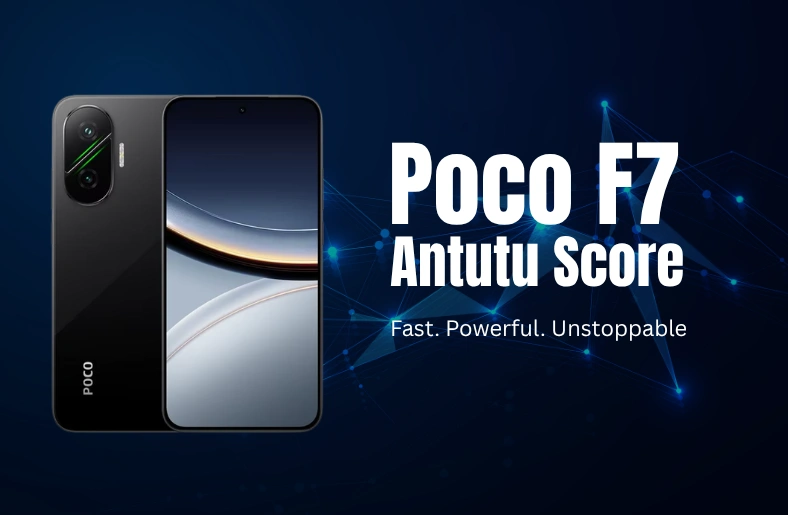
The Poco F7 Antutu Score sits at approximately 2,106,422 on AnTuTu v10 and an average of 2,302,379 on AnTuTu v11 as of 2026 — and after the HyperOS 3 Android 16 update, it still outperforms 94% of all smartphones globally.
Disclaimer: The benchmark scores and performance data in this article are based on publicly reported test results from independent reviewers and verified official sources. Individual results may vary based on software version, ambient temperature, usage patterns, and device configuration. Prices mentioned are accurate as of the last updated date and subject to change.
Quick Stats Snapshot: Poco F7 in 2026
| Attribute | Details |
|---|---|
| Full Name | Xiaomi Poco F7 5G |
| Launch Date | June 24, 2025 (Global); July 1, 2025 (India) |
| Current Software | HyperOS 3 (Android 16) — rolled out Nov 2025 |
| Processor | Qualcomm Snapdragon 8s Gen 4 |
| RAM | 12GB LPDDR5X |
| Storage | 256GB / 512GB UFS 4.1 |
| Display | 6.83-inch 1.5K AMOLED, 120Hz, 3,200 nits |
| Battery (India) | 7,550mAh |
| Battery (Global) | 6,500mAh |
| Charging | 90W Wired + 22.5W Reverse |
| IP Rating | IP68 / IP69 |
| Poco F7 Antutu Score (v10) | ~2,106,422 |
| Poco F7 Antutu Score (v11) | ~2,302,379 |
| Current Price (India, 2026) | ~₹29,999–₹31,999 |
So, What Exactly Is the Poco F7 AnTuTu Score?
The Poco F7 AnTuTu Score is still worth looking at in 2026, even though the phone launched back in 2025. Why? Because it continues to offer excellent performance for its price and can still compete with many newer mid-range phones.
Software updates have also helped. With HyperOS 3 and Android 16, the Poco F7 has received improvements to performance, RAM management, and heat control. So, if you’re thinking about buying the Poco F7 in 2026, its latest AnTuTu performance is still a useful benchmark to consider.
Poco F7 Antutu Score Breakdown Table (2026 Updated)
| Test Category | AnTuTu v10 Score | AnTuTu v11 Score (Avg) |
|---|---|---|
| CPU | 459,592 | 662,243 |
| GPU | 885,193 | 811,615 |
| Memory | 432,778 | 353,648 |
| UX | 328,859 | 458,538 |
| Total Poco F7 Antutu Score | ~2,106,422 | ~2,302,379 |
| Global Percentile | Top 6% | Top 6% |
The Brain Behind the Number: Snapdragon 8s Gen 4
Every conversation about the Poco F7 Antutu Score starts with the Snapdragon 8s Gen 4 — Qualcomm’s “flagship-lite” chip built on TSMC’s 4nm N4P node, carrying the Adreno 825 GPU. It’s the only Qualcomm chip with that specific GPU, which means there’s no confusion about what you’re getting.
CPU Core Layout
| Core Type | Count | Speed | Role |
|---|---|---|---|
| Cortex-X4 (Prime) | 1 | 3.21 GHz | Heavy single-threaded tasks |
| Cortex-A720 (Performance) | 3 | 3.0 GHz | Multitasking & gaming |
| Cortex-A720 (Mid) | 2 | 2.8 GHz | Sustained workloads |
| Cortex-A720 (Efficiency) | 2 | 2.0 GHz | Background tasks |
Poco F7 Geekbench Score: Single-Core and Multi-Core
While the Poco F7 Antutu Score gives the full system picture, Geekbench strips it back to pure CPU performance.
| Benchmark | Score |
|---|---|
| Geekbench 6 Single-Core | 2,085 |
| Geekbench 6 Multi-Core | 6,660 |
| Pre-launch sample (Single-Core) | 1,937 |
| Pre-launch sample (Multi-Core) | 6,021 |
The single-core score of 2,085 is particularly strong, because this is what determines how snappy everyday tasks feel: opening apps, scrolling, typing.
3DMark Wild Life Extreme: The GPU Story
The GPU score inside the Poco F7 Antutu Score (885,193 on v10) is the standout number for gamers. The Adreno 825 is a strong mid-range GPU, and 3DMark confirms it.
| 3DMark Test | Poco F7 Score |
|---|---|
| Wild Life Extreme | 4,363 |
| Steel Nomad | 1,677 |
During extended stress testing, the phone can reach temperatures around 50°C, which triggers thermal throttling. This is a real limitation — not a dealbreaker, but something worth knowing before purchase.
Gaming Performance: What the Poco F7 Antutu Score Really Means in Real Life
Numbers on a screen are nice. But what happens when you actually boot up a game?
Honestly? It’s mostly great. The Poco F7 Antutu Score isn’t just benchmark fluff — the phone genuinely handles popular titles beautifully:
Game Performance Table
| Game | Frame Rate | Notes |
|---|---|---|
| BGMI / PUBG Mobile | Stable 60fps (Ultra settings) | Smooth, responsive, minimal drops |
| Call of Duty: Mobile | 60fps+ at max settings | Impressive sustained performance |
| Real Racing 3 | Smooth 60fps | Minimal thermal impact |
| Genshin Impact | 60fps (Medium-High) | Some thermal throttling after 30 min |
| Asphalt Legends Unite | 60fps Max | Great experience |
The phone’s 6,000mm² dual-inlet vapour chamber (the largest POCO has ever used) helps manage heat during 90-minute gaming sessions, raising the temperature by only about 9.8°C in controlled testing by 91mobiles. That’s a solid result for the Snapdragon 8s Gen 4. However, during extreme stress tests (think back-to-back benchmarks or playing in a hot room while charging), the frame rate can dip noticeably.
Poco F7 Antutu Score vs Rivals in 2026
This is where things get interesting. A year on, how does the Poco F7 Antutu Score compare to what’s currently on shelves?
Updated 2026 Comparison Table
| Phone | Chipset | Antutu Score | 2026 India Price |
|---|---|---|---|
| Poco F7 | Snapdragon 8s Gen 4 | ~2,302,379 (v11) | ~₹29,999 |
| Poco F7 Pro | Snapdragon 8 Gen 3 | ~2,341,443 (v11) | ~₹34,999 |
| Poco F7 Ultra | Snapdragon 8 Elite | ~2,843,461 (v10) | ~₹44,999 |
| iQOO Neo 10 | Snapdragon 8s Gen 4 | ~2,100,000 | ~₹27,999 |
| Realme GT 7T | Snapdragon 8s Gen 4 | ~2,090,000 | ~₹28,999 |
| OnePlus 13R | Snapdragon 8 Gen 3 | ~2,050,000 | ~₹39,999 |
| Samsung Galaxy A56 5G | Exynos 1580 | ~900,000 | ~₹36,999 |
| Samsung Galaxy S26 Ultra | Snapdragon 8 Elite Gen 5 | ~3,905,605 | ~₹1,34,999 |
Two things stand out in 2026. First, the Poco F7 Antutu Score on v11 (2,302,379) now actually edges past the OnePlus 13R and sits very close to the Poco F7 Pro’s 2,341,443 — at a significantly lower price point. Second, it’s now available for less than its launch price (~₹29,999 in India), making the value proposition even sharper.
Battery Performance: The Surprise Standout
Nobody expected a phone with a 2-million-plus Poco F7 Antutu Score to also dominate on battery. But here we are.
Battery Benchmark Results
| Test | Result |
|---|---|
| PCMark Battery Life | 20 hours 36 minutes |
| Battery Capacity (India) | 7,550mAh |
| Battery Capacity (Global) | 6,500mAh |
| Charging Speed | 90W wired |
| Full Charge Time | ~45 minutes |
| Reverse Charging | 22.5W |
The PCMark battery result of 20 hours 36 minutes is genuinely outstanding. In 91mobiles’ testing, the F7 lasted over 5 hours more than the iQOO Neo 10 and about 7 hours more than the Vivo T4 Ultra. The silicon-carbon battery technology (used in the India variant’s 7,550mAh pack) allows for a larger capacity without proportionally increasing the phone’s size or weight.
Thermal Performance: The Real Conversation
Let’s not sugarcoat it. The Poco F7 Antutu Score looks great on paper, but thermal management is the most discussed limitation of this device — and you deserve the full picture.
Thermal Performance Table (2026, Post-HyperOS 3)
| Usage Scenario | Peak Temperature | Real-World Impact |
|---|---|---|
| Browsing / social media | 32–35°C | None whatsoever |
| YouTube / streaming | 34–38°C | None |
| 30-min casual gaming | 38–42°C | Minimal, imperceptible |
| 90-min heavy gaming (BGMI) | ~44–46°C | Minor frame dips, HyperOS 3 manages better |
| 3DMark extreme stress loop | ~50°C | Test can fail in worst-case conditions |
| Gaming while charging | 48–52°C | Performance reduction, no bypass charging |
The 6,000mm² vapour chamber is the largest POCO has ever put in a phone, and post-launch HyperOS updates have improved optimization considerably. For casual and moderate users: don’t worry about it. For competitive mobile gamers who play 2+ hours in one sitting in warm environments: factor it into your decision.
Historical Benchmark Updates: Poco F-Series Performance Over Time
To truly appreciate the Poco F7 Antutu Score, look at where this series has come from.
| Model | Year | Chipset | Antutu Score (Approx.) |
|---|---|---|---|
| Poco F1 | 2018 | Snapdragon 845 | ~280,000 |
| Poco F3 | 2021 | Snapdragon 870 | ~730,000 |
| Poco F4 | 2022 | Snapdragon 870 | ~750,000 |
| Poco F5 | 2023 | Snapdragon 7+ Gen 2 | ~1,020,000 |
| Poco F5 Pro | 2023 | Snapdragon 8+ Gen 1 | ~1,150,000 |
| Poco F6 | 2024 | Snapdragon 8s Gen 3 | ~1,500,000 |
| Poco F6 Pro | 2024 | Snapdragon 8 Gen 2 | ~1,800,000 |
| Poco F7 | 2025–2026 | Snapdragon 8s Gen 4 | ~2,302,379 (v11) |
| Poco F7 Pro | 2025–2026 | Snapdragon 8 Gen 3 | ~2,341,443 (v11) |
| Poco F7 Ultra | 2025–2026 | Snapdragon 8 Elite | ~2,843,461 (v10) |
That’s a roughly 7.5× jump in benchmark performance from the original Poco F1 to the Poco F7. The trajectory is clear: POCO consistently delivers more processing power per rupee with each generation.
Alternatives Worth Considering
The Poco F7 Antutu Score is excellent, but it’s not the only fish in the sea. Here are the best alternatives depending on what you value:
2026 Alternatives Comparison
| Phone | Antutu Score | Battery | 2026 India Price | Best For |
|---|---|---|---|---|
| Poco F7 | ~2,302,379 (v11) | 7,550mAh | ~₹29,999 | Best battery + value combo |
| Poco F7 Pro | ~2,341,443 (v11) | 6,000mAh | ~₹34,999 | Slightly more power, less battery |
| Poco F7 Ultra | ~2,843,461 (v10) | 5,200mAh | ~₹44,999 | No-compromise performance |
| iQOO Neo 10 | ~2,100,000 | 6,400mAh | ~₹27,999 | Budget-first pick |
| OnePlus 13R | ~2,050,000 | 6,000mAh | ~₹39,999 | OxygenOS fans |
| Samsung Galaxy A56 5G | ~900,000 | 5,000mAh | ~₹36,999 | Samsung ecosystem loyalty |