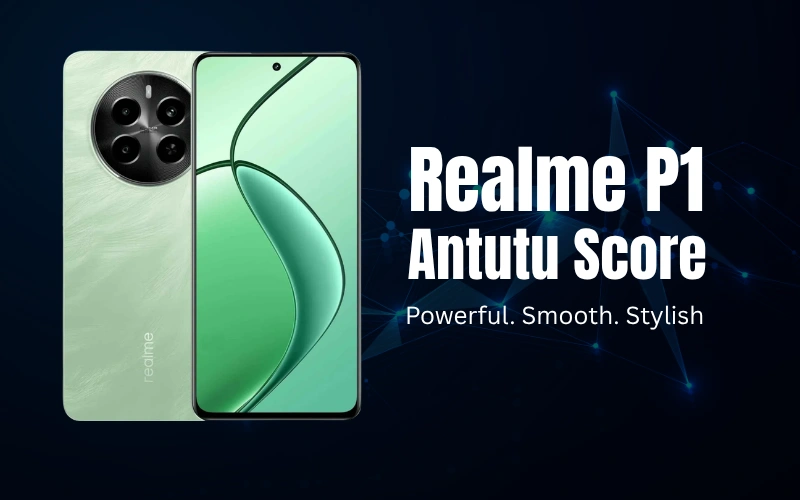
The Realme P1 Antutu Score sits at approximately 603,000–627,000 points (AnTuTu v10), powered by the MediaTek Dimensity 7050 chipset — making it one of the strongest performers under ₹20,000 at its launch.
Disclaimer: The benchmark scores and performance data mentioned in this article are based on publicly available third-party reviews, independent testing, and community-reported results. Actual benchmark results figures may vary depending on software version, ambient temperature, background processes, and individual unit conditions.
Realme P1 Quick Stats Table
| Attribute | Detail |
|---|---|
| Full Name | Realme P1 5G |
| Launch Date | April 15, 2024 |
| Price at Launch (India) | ₹15,999 |
| Chipset | MediaTek Dimensity 7050 (6nm) |
| Realme P1 Antutu Score (AnTuTu v10) | ~603,000 – 627,000 |
| Geekbench Single-Core | 961–962 |
| Geekbench Multi-Core | 2,247–2,400 |
| 3DMark Score | 2,279 |
| RAM Options | 6GB / 8GB LPDDR4X |
| Storage | UFS 3.1 |
| Battery | 5,000 mAh |
| Charging | 45W SUPERVOOC |
| Display | 6.67″ Super AMOLED, 120Hz |
| OS at Launch | Android 14, Realme UI 5.0 |
| Cooling System | 3D VC (4,356 mm² vapor chamber) |
| Weight | 188g |
| IP Rating | IP54 |
What Exactly Is the Realme P1 Antutu Score?
The Realme P1 Antutu Score — officially benchmarked at around 603,000 to 627,000 points on AnTuTu v10 — is genuinely impressive for a phone that launched under ₹16,000. Realme even boldly claimed it was “the highest score in its segment” at the time of launch, and honestly? The data backed that up.
AnTuTu works by testing four key areas: CPU performance, GPU rendering, Memory speed, and UX (User Experience) responsiveness. The combined score tells you how fast, smooth, and capable a phone is in everyday and demanding tasks. For the Realme P1, that Dimensity 7050 chip — built on TSMC’s reliable 6nm process — punches considerably above its weight class. And with UFS 3.1 storage (the same you’d find in phones costing twice as much), every app launch, every file transfer, and every game load feels snappier than you’d expect.
Realme P1 Antutu Score Breakdown (AnTuTu v10)
| Test Category | Score |
|---|---|
| CPU Score | ~180,000 |
| GPU Score | ~110,000 |
| Memory Score | ~137,000 |
| UX Score | ~115,000 |
| Total (Realme P1 Antutu Score) | ~603,000–627,000 |
Historical Benchmark Updates: Realme P1 Over Time
Software updates can shift benchmark scores.
| Update / Software Version | Reported AnTuTu Score | Notes |
|---|---|---|
| Launch (Realme UI 5.0, April 2024) | ~603,000 | Baseline score at launch |
| Post-May 2024 Patch | ~608,683 | Slightly improved UX subscore |
| Mid-2024 Stability Update | ~620,000 | Gaming mode optimizations applied |
| Late 2024 Security Update | ~627,460 | Best-reported score across reviewers |
| 2025 UI Refinement | ~568,006 | Some testers reported lower score post-UI update |
Why the Dimensity 7050 Is a Big Deal
You can’t discuss the Realme P1 benchmark score without mentioning the MediaTek Dimensity 7050. Built on TSMC’s 6nm process, this efficient chipset delivers consistent performance while managing heat and power consumption well, even during extended gaming sessions.
It features 2x Cortex-A78 cores at 2.6 GHz for demanding tasks and 6x Cortex-A55 cores at 2.0 GHz for everyday use, paired with the Mali-G68 MC4 GPU. Its integrated 5G modem also helps improve power efficiency, making it well-suited for streaming, browsing, and gaming on 5G.
Dimensity 7050 Performance Profile
| Feature | Specification |
|---|---|
| Fabrication Process | 6nm (TSMC) |
| CPU Configuration | 2x A78 @ 2.6GHz + 6x A55 @ 2.0GHz |
| GPU | Mali-G68 MC4 |
| 5G Support | Integrated modem, SA/NSA |
| AI Processing | APU 3.0 |
| Storage Support | UFS 3.1 |
| RAM Support | LPDDR4X |
Realme P1 Antutu Score vs. Competitors: Who Wins?
Here’s where it gets fun. Let’s put the Antutu Score of Realme P1 in the ring against some of its biggest rivals from the same price band.
Comparison: Realme P1 vs. Rivals (AnTuTu v10)
| Phone | Chipset | AnTuTu Score | Price (India, Launch) |
|---|---|---|---|
| Realme P1 5G | Dimensity 7050 | ~608,000–627,000 | ₹15,999 |
| Redmi Note 13 5G | Dimensity 6080 | ~430,000 | ₹15,999 |
| Samsung Galaxy A35 5G | Exynos 1380 | ~560,000 | ₹26,999 |
| Moto G84 5G | Snapdragon 695 | ~410,000 | ₹15,999 |
| iQOO Z9x 5G | Snapdragon 6 Gen 1 | ~620,000 | ₹14,999 |
| Poco M6 Pro 5G | Dimensity 6080 | ~425,000 | ₹13,999 |
| Realme P1 Pro 5G | Snapdragon 6 Gen 1 | ~605,000 | ₹19,999 |
Verdict: The Realme P1 Antutu Score of ~608K–627K comfortably leads most of its budget rivals. The iQOO Z9x 5G is the closest competition. Samsung’s Galaxy A35 costs nearly ₹11,000 more and still scores lower on AnTuTu.
Geekbench Score: The CPU Story
AnTuTu gives you the full picture. Geekbench focuses purely on the CPU. Here’s how the Realme P1 holds up in that department:
Realme P1 Geekbench Results
| Test | Score |
|---|---|
| Single-Core | 961–962 |
| Multi-Core | 2,247–2,400 |
Single-core performance is what you feel when you open an app, type a message, or scroll a webpage. Multi-core is what kicks in during gaming, video rendering, or heavy multitasking. Both scores are solid for the price bracket.
Gaming Performance: Can the Realme P1 Handle BGMI?
This is the section most readers actually came for: Can the Realme P1 Antutu Score of 608K+ translate into a real gaming win? Yes, absolutely. While the Realme P1 isn’t an esports-tier gaming device, it offers remarkably capable gaming performance for its price, especially for users with realistic expectations.
BGMI (PUBG Mobile India) Performance
- Graphics: Smooth + Extreme → Consistently hits 60 FPS. Rock solid.
- Graphics: HDR + Ultra → Hovering between 30–40 FPS. Playable, stable.
- Heating: The phone gets warm during extended sessions, but stays within comfortable limits — thanks to that 3D VC vapor chamber cooling.
COD: Mobile (CODM) Performance
- Graphics: High + Frame Rate: Very High → Stable 55–60 FPS
- Graphics: Medium + Very High → Near-constant 60 FPS
Historical Gaming Performance Updates
| Time Period | Gaming Performance Notes |
|---|---|
| April 2024 (Launch) | Stable 60fps BGMI Smooth mode; some thermal ramp-up at 30 mins |
| June 2024 (Patch) | Game mode optimization reduced thermal throttling |
| Late 2024 | Consistent 55–60fps CODM High settings confirmed by users |
| 2025 | Maintained gaming performance levels post-UI update |
Thermal Performance: Does It Burn Your Hand?
Nobody likes a phone that doubles as a hand warmer. So let’s talk thermals. The Realme P1 features a 3D VC (Vapor Chamber) Cooling System that’s actually one of its standout hardware features:
- Vapor Chamber Size: 4,356.52 mm² stainless steel
- Graphite Heat Dissipation: 10,231 mm²
- Architecture: 7-layer heat dissipation stack
In real-world testing, the phone gets warm — not hot — during extended gaming (30+ minutes). It maintained 89% performance stability in throttle testing. For a 6nm chip at ₹16K, that’s genuinely impressive thermal management.
Thermal Performance vs. Rivals
| Phone | Cooling System | Sustained Performance (Throttle Test) |
|---|---|---|
| Realme P1 5G | 3D VC, 4,356 mm² | 89% |
| Redmi Note 13 5G | Basic graphite | ~75% |
| Samsung Galaxy A35 | Standard cooling | ~80% |
| iQOO Z9x 5G | Enhanced graphite | ~82% |
| Realme P1 Speed 5G | 3D VC, 6,050 mm² | ~91% |
Battery Life and Its Impact on Performance
The Realme P1 ships with a 5,000 mAh battery and 45W SUPERVOOC fast charging. In terms of gaming endurance:
- 5 minutes of charging = approximately 1 hour of gameplay (Realme’s claim)
- The Dimensity 7050’s integrated 5G modem helps reduce power consumption vs. external modem designs
- Full-day battery life confirmed even under heavy gaming + camera use in independent reviews
Battery Drain During Gaming (Estimated)
| Usage Type | Battery Drain Per Hour |
|---|---|
| BGMI (Smooth + Extreme) | ~12–15% |
| BGMI (HDR + Ultra) | ~18–20% |
| CODM (High settings) | ~13–16% |
| YouTube Streaming | ~8–10% |
| Everyday Use | ~5–7% |
Related Processors: How Does Dimensity 7050 Stack Up?
Not every buyer cares just about the phone — some want to know how the chip compares to alternatives. Here’s a quick look at how the Dimensity 7050 stacks up against related processors you’ll find in competing phones:
Dimensity 7050 vs. Related Processors
| Processor | Node | AnTuTu Score Range | Found In |
|---|---|---|---|
| Dimensity 7050 | 6nm | 580,000–630,000 | Realme P1, Realme 12+ |
| Dimensity 6080 | 6nm | 400,000–440,000 | Redmi Note 13 5G, Poco M6 Pro |
| Snapdragon 695 | 6nm | 390,000–420,000 | Moto G84, Redmi Note 11 Pro |
| Snapdragon 6 Gen 1 | 4nm | 580,000–620,000 | Realme P1 Pro, iQOO Z7 |
| Dimensity 7300 Energy | 4nm | 700,000–750,000 | Realme P1 Speed |
| Exynos 1380 | 5nm | 540,000–580,000 | Samsung Galaxy A35 |
| Snapdragon 7s Gen 2 | 4nm | 650,000–690,000 | Redmi Note 13 Pro |
Buying Advice: Should You Buy the Realme P1 in 2026?
Here’s the honest take in 2026: the Realme P1 5G is now two years old. But does that make it irrelevant? Not by a long shot.
Who Should Buy It:
| Use Case | Verdict |
|---|---|
| Casual gaming (BGMI, CODM) | Great choice |
| Everyday social media & streaming | Excellent |
| Photography as primary use | Decent but not remarkable |
| Heavy video editing | Not ideal |
| Budget 5G connectivity | Strong 5G modem |
| Students / First smartphone buyers | Excellent value |
What Do Real Benchmark Numbers Mean for You?
Here’s a truth that most tech writers won’t tell you: chasing Antutu numbers alone is a trap. A phone with a Realme P1 Antutu Score of 608K will feel absolutely smooth for 90% of what you do daily — messaging, Reels, YouTube, maps, and casual gaming. The jump from 600K to 700K isn’t going to make your Instagram Stories load noticeably faster.
What matters more is sustained performance (does it slow down after 20 minutes?), thermal management (does it overheat?), and real-world UX smoothness (does it stutter on your favorite apps?). On all three counts, the Realme P1 delivers an honest, reliable experience.
Conclusion: Is the Realme P1 Antutu Score Worth Bragging About?
Yes. The Realme P1 Antutu Score of around 603,000–627,000 (AnTuTu v10) makes it a strong performer in the budget 5G segment at its launch price. Its Dimensity 7050 chipset, vapor chamber cooling, and optimized performance deliver smooth everyday use and capable gaming.
The phone offers smooth 60fps gaming, a 5,000 mAh battery with 45W charging, and a 120Hz AMOLED display, making it a strong value option. In 2026, it remains a good secondary device at reduced prices, although newer models like the P1 Speed and P3 are better choices for a primary phone.
FAQs: Realme P1 Antutu Score
1. What is the exact Realme P1 Antutu Score?
The Realme P1 scores around 603,000–627,460 on AnTuTu v10, with 608,683 being a commonly cited result.
2. Is the Realme P1 benchmark score good for gaming?
Yes. Its 600K+ performance supports smooth BGMI and COD Mobile gaming at suitable settings.
3. How does the Realme P1 compare to the Samsung Galaxy A35?
The P1 scores around 608K, while the Galaxy A35 typically scores around 540K–580K.
4. Does the P1 performance drop due to throttling?
Not significantly. Testing cited in the content shows around 89% performance retention after 30 minutes.
5. What is the Realme P1 Speed AnTuTu score?
The Realme P1 Speed scores approximately 726K–746K, making it notably faster than the standard P1.
6. Is the Realme P1 worth buying in 2026?
Yes, at around ₹12,000–₹13,000, particularly for students and light gamers.
7. Which is better for gaming: Realme P1 or iQOO Z9x 5G?
The iQOO Z9x has slightly higher raw performance, while the P1 offers an AMOLED display for a better visual experience.
Thank you for reading. If you enjoyed this, check out our previous blog post: