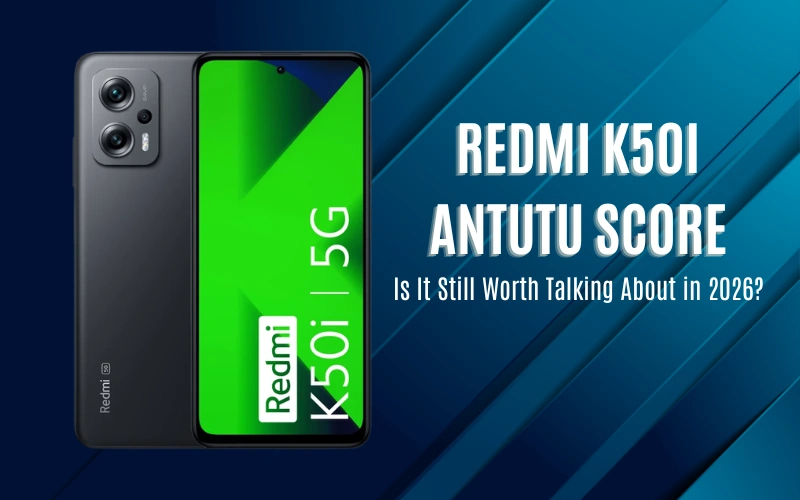
The Redmi K50i AnTuTu Score sits around 800,000 to 822,000 points on AnTuTu’s official benchmark, powered by the MediaTek Dimensity 8100 chipset, making it a genuinely strong mid-range performer even by 2026 standards.
Disclaimer: This article is intended for informational purposes only. Benchmark scores, including the Redmi K50i AnTuTu Score, can vary based on software version, unit variation, and testing conditions. Readers making purchase decisions are encouraged to cross-check current figures directly through the official AnTuTu app or website, and consult recent hands-on reviews for the most accurate, up-to-date performance data.
Quick Stats Table: Redmi K50i at a Glance
| Particulars | Details |
|---|---|
| Phone Name | Redmi K50i 5G (also sold as Poco X4 GT in global markets) |
| Processor | MediaTek Dimensity 8100 |
| Fabrication Process | 5nm |
| CPU Configuration | Octa-core (4x Cortex-A78 @ 2.85GHz + 4x Cortex-A55 @ 2.0GHz) |
| GPU | Mali-G610 MC6 |
| Redmi K50i AnTuTu Score (Overall) | Approx. 800,000 – 822,000 |
| AnTuTu CPU Score | Approx. 178,000 |
| AnTuTu GPU Score | Approx. 308,000 |
| AnTuTu Memory Score | Approx. 151,000 |
| AnTuTu UX Score | Approx. 162,000 |
| RAM Options | 6GB / 8GB / 12GB |
| Storage Options | 128GB / 256GB |
| Display | 6.6-inch FHD+, 144Hz refresh rate |
| Battery | 5080mAh with 67W fast charging |
| Launch Year | 2022 |
Note: AnTuTu scores fluctuate across app versions (v9, v10) and firmware updates. Figures above are aggregated from multiple benchmark tracking platforms as of August 2026. For the most precise, unit-specific number, cross-check with AnTuTu’s official app or website directly.
What Is the Redmi K50i AnTuTu Score, Really?
Let’s start with the basics, because not everyone reading this lives and breathes benchmark charts. AnTuTu is essentially a stress test for your phone. It pushes the processor, graphics chip, memory, and overall system responsiveness to their limits, then spits out a single number representing overall muscle power. A higher number generally means smoother gaming, faster app switching, and less lag when you’re juggling fifteen browser tabs at once.
The Redmi K50i AnTuTu Score lands in the 800,000-point neighborhood, which back in 2022 was genuinely flagship-tier territory. Xiaomi even made a bit of noise about it at launch, publicly comparing the number against the Snapdragon 888 and Apple’s A15 Bionic chip — and winning that comparison, at least on paper.
Here’s the thing about benchmark bragging rights, though — they age. A score that looked incredible in 2022 needs fresh context in 2026, which is exactly what we’re about to give it.
Breaking Down the Redmi K50i AnTuTu Score by Category
AnTuTu doesn’t just hand you one number and call it a day. It splits performance into four buckets, and understanding each one tells you a lot more than the headline figure alone.
| Category | Score | What It Actually Means |
|---|---|---|
| CPU | ~178,000 | How fast the phone handles calculations, multitasking, and app logic |
| GPU | ~308,000 | How smoothly games and visual effects render |
| Memory | ~151,000 | How quickly the phone reads and writes data (RAM/storage speed) |
| UX (User Experience) | ~162,000 | Real-world responsiveness — scrolling, app launches, touch response |
Redmi K50i AnTuTu Score vs Rival Chipsets: The Comparison Chart
You don’t really know if a number is good until you see it next to other numbers. So here’s how the Redmi K50i AnTuTu Score stacks up against chipsets it was originally pitched against, plus a few more recent comparisons for context.
| Phone / Chipset | AnTuTu Score (Approx.) | Launch Era |
|---|---|---|
| Redmi K50i (Dimensity 8100) | 800,000 – 822,000 | 2022 |
| Snapdragon 888 (reference) | 804,131 | 2021 |
| Apple A15 Bionic (reference) | 782,653 | 2021 |
| Redmi K50 (Snapdragon 8 Gen 1) | ~824,926 | 2022 |
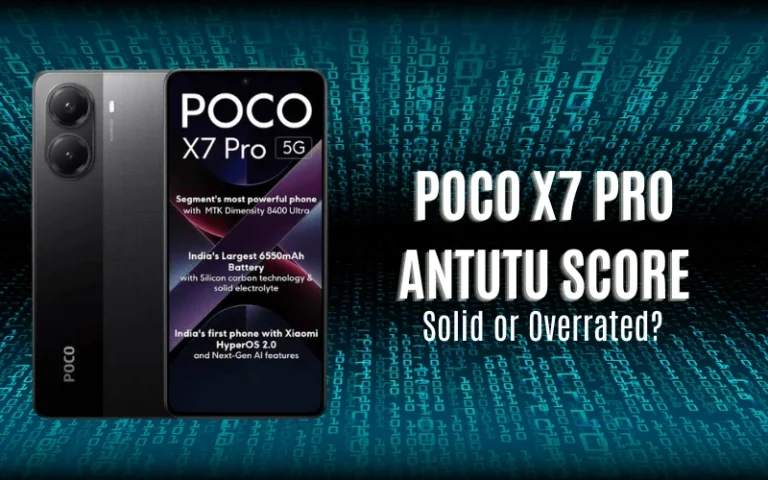
| POCO X7 Pro (Dimensity 8400 Ultra) | 1,636,312 | 2025 |
The comparison against the Snapdragon 888 and A15 Bionic is exactly why the Redmi K50i AnTuTu Score made headlines at launch — it genuinely edged past two chips that flagship phones were built around. But look at that last row. A 2025 mid-ranger like the POCO X7 Pro roughly doubles the K50i’s number. That’s just how fast mobile chip technology moves. A great score in 2022 becomes a merely decent score by 2026, and that’s not a knock on the K50i — it’s simply the nature of the benchmark race.
Gaming Performance: Does the Number Translate to Real Play?
Benchmarks are great on paper, but let’s talk about what actually matters — can you play your favorite games without your thumbs suffering through lag and stutter?
Thanks to that strong GPU score, the Redmi K50i handles most popular titles comfortably. Games like BGMI and Call of Duty Mobile run at high settings with stable frame rates, and the 144Hz display genuinely helps games that support higher refresh rates feel noticeably smoother in casual play.
| Game | Expected Settings | Real-World Experience |
|---|---|---|
| BGMI | HD / Ultra graphics | Smooth, occasional frame drops in intense scenes |
| Call of Duty Mobile | High / Max graphics | Consistently smooth gameplay |
| Genshin Impact | Medium settings | Playable, some frame dips during heavy effects |
| Asphalt 9 | High graphics | Smooth with good visual fidelity |
Thermal Performance: What Happens When You Push It
This is the part benchmark charts conveniently leave out, and it’s genuinely important. A phone can post an impressive Redmi K50i AnTuTu Score in a quick five-minute test and still struggle to maintain that performance over a longer gaming session, because processors throttle (slow themselves down) once they heat up.
The Dimensity 8100 inside the K50i is built on a 5nm process, which is generally efficient, but the phone’s plastic back and mid-range cooling setup mean it does warm up noticeably during extended gaming sessions, especially in warmer climates. Most users report the phone staying comfortably usable, with only mild warmth around the camera module area after 30-plus minutes of intensive gaming — nothing alarming, but worth knowing before a long gaming binge on a hot afternoon.
Battery Impact: How Much Juice Does Gaming Actually Eat?
A great Redmi K50i AnTuTu Score means nothing if your battery taps out an hour into a gaming session. Thankfully, this is one area where the K50i genuinely shines. The 5080mAh battery is on the larger side even by today’s standards, and paired with the 5nm chip’s power efficiency, it delivers commendable gaming stamina.
| Activity | Approximate Battery Drain (Per Hour) |
|---|---|
| Casual browsing / social media | 8% – 10% |
| Video streaming | 10% – 12% |
| Light gaming (casual titles) | 12% – 15% |
| Heavy gaming (BGMI, COD Mobile) | 18% – 22% |
Combine that battery capacity with 67W fast charging, and you get a phone that can go from empty to roughly 50% in about 15 minutes — a genuinely useful safety net if you’re rushing out the door and realize your phone is nearly dead.
Redmi K50i Alternatives: What Else Should You Consider in 2026?
If you’re shopping in 2026 and the Redmi K50i has caught your eye purely because of its historically strong AnTuTu number, it’s worth knowing what else is available at similar or better price points today.
| Alternative Phone | Chipset | Why Consider It |
|---|---|---|
| POCO X7 Pro | Dimensity 8400 Ultra | Roughly double the AnTuTu score, newer efficiency gains |
| Redmi Note 14 Pro+ | Dimensity 7300 Ultra | Better camera setup, similar price bracket |
| Realme GT 6 | Snapdragon 8s Gen 3 | Stronger sustained gaming performance |
| iQOO Z9x | Snapdragon 6 Gen 1 | Budget-friendly with solid daily performance |
Related Processors: Understanding the Dimensity 8100 Family
The chipset behind the Redmi K50i AnTuTu Score doesn’t exist in isolation — MediaTek built an entire family around the Dimensity 8100, and knowing where it sits helps you understand the phone’s actual positioning.
| Processor | Relation to Dimensity 8100 | Performance Positioning |
|---|---|---|
| Dimensity 8100 Max | Slightly overclocked variant | Marginally higher clock speeds |
| Dimensity 8200 | Successor chip | Improved efficiency and slightly better GPU |
| Dimensity 8300 | Next-gen successor | Newer core architecture (Cortex-A715/A510) |
| Dimensity 8400 Ultra | Latest generation (2025) | Roughly double the raw AnTuTu performance |
Historical Updates: How the Redmi K50i AnTuTu Score Has Shifted Over Time
Benchmark numbers aren’t set in stone. They shift with software updates, AnTuTu app version changes, and even Android OS updates. Here’s how the publicly tracked Redmi K50i AnTuTu Score has moved across different points in its lifecycle.
| Time Period | Approximate AnTuTu Score | Context |
|---|---|---|
| Launch (July 2022) | 822,274 | Official score shared by Redmi at launch, AnTuTu v9 |
| Mid-2023 | ~815,000 | Minor fluctuation post software updates |
| 2024 | ~811,000 | AnTuTu v10 recalibration affects comparability |
| 2026 (Current tracking) | 800,000 – 815,000 | Stable across multiple tracking platforms |
Buying Advice: Is the Redmi K50i Still Worth It in 2026?
Let’s bring this home with some straightforward, no-nonsense advice.
- If you’re buying secondhand or heavily discounted: Absolutely worth considering. The performance-per-rupee is still solid for casual gaming and daily use.
- If you’re comparing it against brand-new 2026 releases at full price: Newer chipsets like the Dimensity 8400 Ultra will give you noticeably better performance for similar money.
- If your priority is battery life over raw power: The 5080mAh battery and 67W charging remain genuinely competitive even against newer phones.
- If competitive gaming (high FPS, zero lag) is your top priority: Consider a newer chipset, since the K50i, while capable, isn’t built for the absolute cutting edge of mobile gaming anymore.
Conclusion: The Real Story Behind the Redmi K50i AnTuTu Score
Here’s what it all comes down to. The Redmi K50i AnTuTu Score — sitting comfortably in the 800,000 to 822,000 range — was a genuine standout when the phone launched in 2022, comfortably outperforming flagship-grade chips of that era. Years later, it hasn’t degraded meaningfully; the small fluctuations you see across tracking platforms come down to benchmark app recalibrations, not hardware decline.
That said, the mobile chip race hasn’t stood still. Newer processors like the Dimensity 8400 Ultra have roughly doubled that number, which means the K50i’s benchmark bragging rights have naturally faded with time. What hasn’t faded is its real-world reliability — solid gaming performance, respectable thermal behavior, and genuinely strong battery stamina.
Frequently Asked Questions
1. What is the exact Redmi K50i AnTuTu Score?
The Redmi K50i AnTuTu Score ranges between approximately 800,000 and 822,274 points, depending on the AnTuTu app version and specific unit tested, with the official launch figure at 822,274.
2. Which processor powers the Redmi K50i?
It runs on the MediaTek Dimensity 8100, a 5nm chipset with an octa-core CPU configuration and a Mali-G610 MC6 GPU.
3. Is the Redmi K50i AnTuTu Score good in 2026?
It’s still respectable for everyday use and casual-to-moderate gaming, but newer 2025-2026 mid-range chipsets, like the Dimensity 8400 Ultra, score nearly double, so it’s no longer class-leading.
4. Does the Redmi K50i overheat during gaming?
It warms up moderately during extended gaming sessions, particularly in warm environments, but most users report it remains comfortably usable without severe thermal throttling.
5. How does the Redmi K50i AnTuTu Score compare to the Redmi K50?
The Redmi K50, powered by the Snapdragon 8 Gen 1, scores slightly higher at around 824,926 points, though both phones perform similarly in real-world day-to-day use.
6. What are the best alternatives to the Redmi K50i in 2026?
Options like the POCO X7 Pro, Redmi Note 14 Pro+, and Realme GT 6 offer noticeably better benchmark numbers and updated hardware for similar or slightly higher price points.
Thank you for reading. If you enjoyed this, check out our previous blog post:
- Helio G99 Antutu Score
- The Antutu Score
- Tensor G5 AnTuTu Score
- Nothing Phone 1 Antutu Score
- Xiaomi Pad 7 Antutu Score
- Tech Alaikas
- Samsung S24 FE Antutu Score
- iPhone 12 Antutu Score
- OnePlus 15R AnTuTu Score
- Infinix GT 20 Pro Antutu Score
For SEO & Website Analysis Tools insights and official testing resources, visit the official website: Tools by Alaikas.