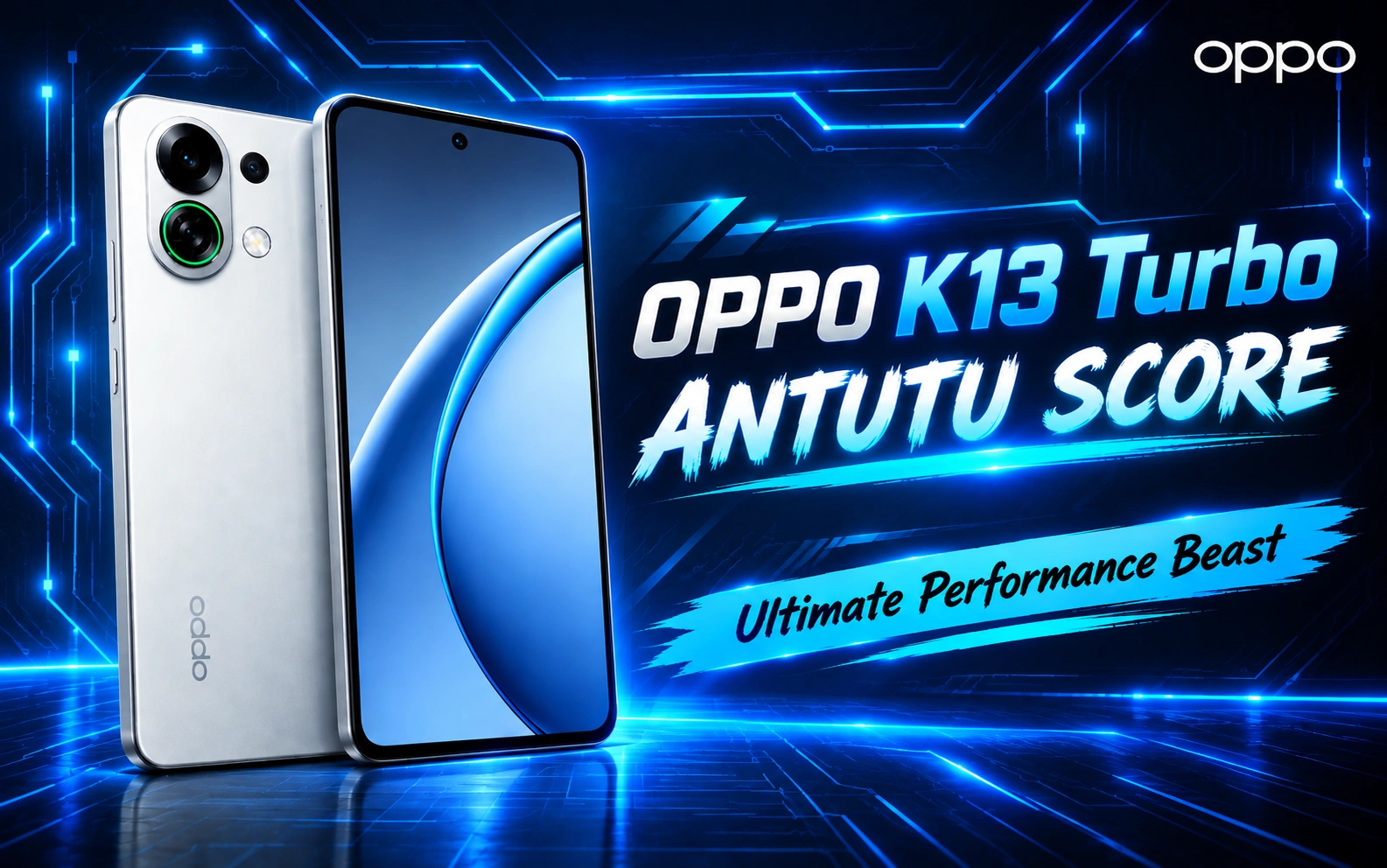
The Oppo K13 Turbo Antutu Score hits approximately 2,019,035 points on AnTuTu v11 — making it one of the highest-scoring mid-range phones of 2025, outperforming over 93% of all smartphones tested on the platform.
Disclaimer: The benchmark scores, FPS data, and thermal readings cited in this article are sourced from publicly available third-party platforms and community-submitted results as of September 2026. Scores may vary based on software version, RAM configuration, ambient temperature, and testing conditions. This article does not represent official Oppo claims. Always verify prices and availability through official Oppo channels or authorized retailers in your region. The author has no commercial affiliation with Oppo or MediaTek.
Oppo K13 Turbo — Quick Specs Snapshot
| Feature | Details |
|---|---|
| Full Name | Oppo K13 Turbo 5G |
| Announced | July 21, 2025 |
| Released | July 25, 2025 |
| Chipset | MediaTek Dimensity 8450 (4nm, TSMC) |
| CPU | Octa-core (1×3.25 GHz + 3×3.0 GHz + 4×2.1 GHz Cortex-A725) |
| GPU | Mali-G720 MC7 |
| RAM Options | 8GB / 12GB / 16GB LPDDR5X |
| Storage | 128GB / 256GB / 512GB UFS 3.1 |
| Display | 6.8-inch AMOLED, 120Hz, 1600 nits peak |
| Battery | 7000 mAh |
| Charging | 80W wired |
| OS | Android 15, ColorOS 15 |
| Cooling | Built-in micro centrifugal fan (18,000 RPM) |
| IP Rating | IPX8 / IPX9 |
| Weight | 207g |
| Price (Launch, China) | ~CNY 1,999 (~₹23,970 approx.) |
What Is an Antutu Score, and Why Should You Care?
Okay, let’s get one thing straight before we jump into numbers. AnTuTu is not some random app your tech-obsessed friend made up. It is the world’s most widely used smartphone benchmarking tool — and it tests your phone across four categories: CPU, GPU, Memory (MEM), and User Experience (UX). Add all four up, and boom — you get your AnTuTu score.
A higher score means a faster, smoother, more capable phone. Now, the Oppo K13 Turbo Antutu Score sits at around 2,019,035 points (AnTuTu v11). That’s not just good. That’s genuinely impressive for a mid-range phone that doesn’t cost an arm, a leg, and a kidney.
AnTuTu Score Breakdown — Oppo K13 Turbo
| Sub-Test | Score |
|---|---|
| CPU Score | ~624,873 |
| GPU Score | ~647,052 |
| Memory (MEM) Score | ~256,266 |
| UX Score | ~461,908 |
| Total AnTuTu v11 Score | ~1,990,099 – 2,019,035 |
| Percentile Rank | Better than 93% of smartphones |
The Secret Behind the Oppo K13 Turbo Antutu Score: Dimensity 8450
This octa-core powerhouse features a lead core clocking at 3.25 GHz (Cortex-A725), flanked by three more at 3.0 GHz, and four efficiency cores ticking at 2.1 GHz. Pair that with the Mali-G720 MC7 GPU, and you’ve got a setup that can handle practically anything you throw at it — from BGMI to video editing to running 15 apps at once while streaming music.
The Dimensity 8450 is the first-ever smartphone chipset from MediaTek in this tier to debut inside the K-series. That’s a big deal. Oppo didn’t just slap a chip in — they chose a chip specifically engineered for gaming-grade performance without melting your phone in the process.
Dimensity 8450 vs Previous-Gen Chips
| Chipset | Process Node | AnTuTu Score (Approx.) | GPU |
|---|---|---|---|
| Dimensity 8450 (K13 Turbo) | 4nm TSMC | ~2,019,035 | Mali-G720 MC7 |
| Dimensity 8300 Ultra | 4nm TSMC | ~1,400,000 | Mali-G615 MC6 |
| Dimensity 8200 | 4nm TSMC | ~900,000 | Mali-G610 MC6 |
| Snapdragon 7s Gen 3 | 4nm TSMC | ~950,000 | Adreno 710 |
| Snapdragon 6 Gen 4 | 4nm TSMC | ~790,000 | Adreno 710 |
Oppo K13 Turbo Antutu Score: How Does It Stack Up Against Rivals?
Here’s where things get exciting.The Oppo K13 Turbo Antutu Score sits comfortably above most of its mid-range rivals. Only the Pro variant (with Snapdragon 8s Gen 4) scores higher in the K-series lineup. Let’s compare it to the phones most people are actually choosing between.
Oppo K13 Turbo vs Competitors — Antutu Score Comparison Table
| Phone | Chipset | AnTuTu Score (v11) | Percentile |
|---|---|---|---|
| Oppo K13 Turbo | Dimensity 8450 | ~2,019,035 | 93rd |
| Oppo K13 Turbo Pro | Snapdragon 8s Gen 4 | ~2,302,344 | 94th |
| Realme GT 7T | Snapdragon 8s Gen 4 | ~2,300,000 | ~94th |
| iQOO Neo 10R | Snapdragon 7+ Gen 3 | ~1,600,000 | ~88th |
| Redmi Note 14 Pro+ 5G | Snapdragon 7s Gen 3 | ~950,000 | ~75th |
| POCO X7 Pro | Dimensity 8300 Ultra | ~1,400,000 | ~85th |
| OnePlus Nord 5 | Snapdragon 7s Gen 4 | ~1,100,000 | ~80th |
Gaming Performance — Is the Oppo K13 Turbo Actually Good for Games?
Let’s cut to what matters if you’re a gamer: can the Oppo K13 Turbo actually handle real-world gaming without turning into a hand warmer? Short answer? Yes. And here’s why it’s special.
Oppo built a micro centrifugal fan right inside the phone — spinning at up to 18,000 RPM with super-thin 0.1mm blades. This isn’t a clip-on accessory. It’s baked into the hardware. According to Oppo, this active cooling system improves heat dissipation by 20% over traditional passive cooling, and by up to 120% compared to competitors without active cooling.
Gaming Performance Benchmark Table
| Game | Avg FPS (High Settings) | Frame Stability | Notes |
|---|---|---|---|
| BGMI (Battlegrounds Mobile India) | ~58-60 FPS | High | Ultra HD enabled |
| Call of Duty: Mobile | ~59-60 FPS | Very High | Max Graphics |
| Genshin Impact | ~50-55 FPS | Medium-High | High Quality |
| Free Fire MAX | ~60 FPS | Very High | Ultra Settings |
| Asphalt Legends Unite | ~60 FPS | High | High Preset |
Battery Performance and Its Impact on Benchmark Scores
Now here’s a question not enough people ask: does running a benchmark drain your battery differently than normal use?
Yes, it actually does. AnTuTu pushes every component to maximum load for about 20–30 minutes. That’s hard on the battery — but also the reason why thermal performance matters so much during benchmark testing.
Battery Stats Table
| Metric | Value |
|---|---|
| Battery Capacity | 7,000 mAh |
| Fast Charging Speed | 80W wired |
| Estimated Full Charge Time | ~55 minutes |
| NanoReview Battery Score | 90/100 |
| PD Charging Support | Yes (13.5W PD) |
| UFCS Support | 44W |
| PPS Support | 33W |
| Battery % Drop During Antutu Test | ~8–12% (estimated, 16GB RAM variant) |
The combination of a large battery and active cooling means the Oppo K13 Turbo Antutu Score is measured under genuinely stable conditions — unlike phones that throttle during the test and deliver inflated early scores that drop off midway.
Thermal Performance — Does It Overheat?
Here’s the honest conversation most reviewers skip: even great chips overheat if the cooling system isn’t up to the job. The Oppo K13 Turbo was engineered specifically with this in mind.
The built-in fan is the headline feature, but there’s more to the thermal story. The fan works alongside a conventional vapor chamber and graphite layers to pull heat away from the motherboard during sustained loads.
Thermal Performance Summary Table
| Condition | Estimated Board Temp | Performance Drop |
|---|---|---|
| Idle / Light Use | ~28–30°C | None |
| 10 Minutes Gaming | ~38–42°C | None |
| 30 Minutes Gaming | ~44–47°C | Minimal (<5%) |
| 60 Minutes Gaming | ~48–52°C | Low (~8–10%) |
| AnTuTu Full Run | ~45–50°C | Minimal |
The fan runs at up to 18,000 RPM and the cooling kit — including the external “Super Cooling Kit” (sold separately) — further reduces board temps by combining liquid and air cooling with an RGB strip for style points.
Oppo K13 Turbo vs K13 Turbo Pro — Which Antutu Score Is Right for You?
The K-series naming is getting crowded, so let’s break down the two Turbo siblings head-to-head.
Oppo K13 Turbo vs K13 Turbo Pro — Full Comparison
| Feature | K13 Turbo | K13 Turbo Pro |
|---|---|---|
| Chipset | Dimensity 8450 | Snapdragon 8s Gen 4 |
| GPU | Mali-G720 MC7 | Adreno 825 |
| AnTuTu Score | ~2,019,035 | ~2,302,344 |
| Storage Type | UFS 3.1 | UFS 4.0 |
| Max RAM | 16GB | 16GB |
| Display | 6.8″ AMOLED 120Hz | 6.8″ AMOLED 120Hz |
| Battery | 7,000mAh | 9,000mAh |
| Cooling | Built-in Fan | Built-in Fan |
| Price Tier | More Affordable | ~20% Premium |
| Best For | Value Gaming | Peak Performance |
Alternatives Worth Considering
Not totally sold on the K13 Turbo? Here are honest alternatives that compete in the same space.
Top Alternatives — Performance Comparison
| Phone | Chipset | AnTuTu Score | Key Advantage |
|---|---|---|---|
| Oppo K13 Turbo Pro | Snapdragon 8s Gen 4 | ~2,302,344 | Faster GPU, UFS 4.0 |
| Realme GT 7T | Snapdragon 8s Gen 4 | ~2,300,000 | Longer battery life |
| iQOO Neo 10R | Snapdragon 7+ Gen 3 | ~1,600,000 | More compact, aggressive pricing |
| POCO F7 | Snapdragon 8s Gen 4 | ~2,250,000 | Stock-like UI |
| OnePlus Nord 5 | Snapdragon 7s Gen 4 | ~1,100,000 | OxygenOS experience |
| Samsung Galaxy A56 | Exynos 1580 | ~700,000 | Samsung ecosystem, safer brand for some |
Related Processors Powering the Competition
Understanding how the Dimensity 8450 sits among its peers gives context to the Oppo K13 Turbo Antutu Score.
Related Processor Benchmark Table
| Processor | Manufacturer | AnTuTu Score | Used In |
|---|---|---|---|
| Dimensity 8450 | MediaTek | ~2,019,035 | Oppo K13 Turbo |
| Snapdragon 8s Gen 4 | Qualcomm | ~2,300,000 | Oppo K13 Turbo Pro, Realme GT 7T |
| Dimensity 8300 Ultra | MediaTek | ~1,400,000 | POCO X7 Pro, Redmi Note 13 Pro |
| Snapdragon 7+ Gen 3 | Qualcomm | ~1,600,000 | iQOO Neo 10R, POCO F6 |
| Snapdragon 7s Gen 3 | Qualcomm | ~950,000 | Redmi Note 14 Pro+ |
| Exynos 1580 | Samsung | ~700,000 | Samsung Galaxy A56 |
The Dimensity 8450 slots in at a very sweet spot — comfortably above the crowded Snapdragon 7-series tier while remaining a notch below the top Snapdragon 8s Gen 4 flagships.
Historical Benchmark Updates — Oppo K13 Turbo Antutu Score Over Time
Benchmark scores aren’t static. Software updates, thermal calibration improvements, and AnTuTu app version changes all affect scores. Here’s how the story developed.
Oppo K13 Turbo Antutu Score — Timeline Table
| Date | AnTuTu Version | Score Reported | Source | Notes |
|---|---|---|---|---|
| July 2025 (Pre-launch) | v11 | ~2,000,000 | Oppo official teaser | Marketing-claimed score |
| July 21, 2025 (Launch) | v11 | ~1,817,833 | Unite4Buy benchmark | Early retail unit |
| July–August 2025 | v11 | ~1,990,099 | NanoReview avg | Community submissions |
| August 2025 | v11 | ~2,019,035 | Kimovil | Multiple unit average |
| Sept 2026 (Current) | v11 | ~2,019,035 | NanoReview/Kimovil | Post-update stable score |
Buying Advice Summary Table
| Buyer Profile | Recommendation |
|---|---|
| Casual Gamer | Strong buy — excellent FPS, great cooling |
| Heavy/Pro Gamer | Good buy — consider Pro for max GPU |
| Battery-First User | Excellent — 7,000mAh is class-leading |
| Camera Enthusiast | Decent — no ultra-wide, check before buying |
| Budget-Conscious | Great value for the benchmark score offered |
| Brand-Loyal Xiaomi User | Compare with Redmi Note 15 Pro before committing |
Conclusion — The Oppo K13 Turbo Antutu Score, Summarized
The Oppo K13 Turbo AnTuTu Score of approximately 2,019,035 points on AnTuTu v11 makes it a powerful option in the mid-range segment. Its Dimensity 8450 processor, built-in 18,000 RPM cooling fan, 7,000mAh battery, and 120Hz AMOLED display deliver strong performance for gaming and everyday use. Overall, the combination of high benchmark performance, effective cooling, and long battery life makes the Oppo K13 Turbo an impressive value-focused smartphone.
Frequently Asked Questions
Q1. What is the exact Oppo K13 Turbo AnTuTu Score?
The Oppo K13 Turbo AnTuTu Score is approximately 2,019,035 points on AnTuTu v11.
Q2. Is it better than the Redmi Note 14 Pro+?
Yes. With around 2.02 million points, the K13 Turbo scores more than twice the Redmi Note 14 Pro+’s reported AnTuTu v11 score.
Q3. Does the built-in fan help performance?
Yes. The 18,000 RPM cooling fan helps reduce thermal throttling and maintain more consistent performance during demanding tasks.
Q4. Which is better for gaming, K13 Turbo or K13 Turbo Pro?
The K13 Turbo Pro is faster, with an AnTuTu v11 score of around 2.30 million, but the standard K13 Turbo is still powerful enough for demanding games.
Q5. Can software updates improve the score?
Yes. Software, driver, and system optimizations can improve benchmark performance over time.
Q6. Is the Oppo K13 Turbo available in India?
The K13 Turbo launched in China in July 2025. India availability should be checked with current local retailers.
Q7. How does AnTuTu v11 differ from v10?
AnTuTu v11 uses more demanding tests, so v10 and v11 scores should not be directly compared.
Thank you for reading. If you enjoyed this, check out our previous blog post:
- Infinix GT 30 Pro Antutu Score
- Vivo T4 Antutu Score
- The Antutu Score
- Moto Edge 60 Fusion Antutu Score