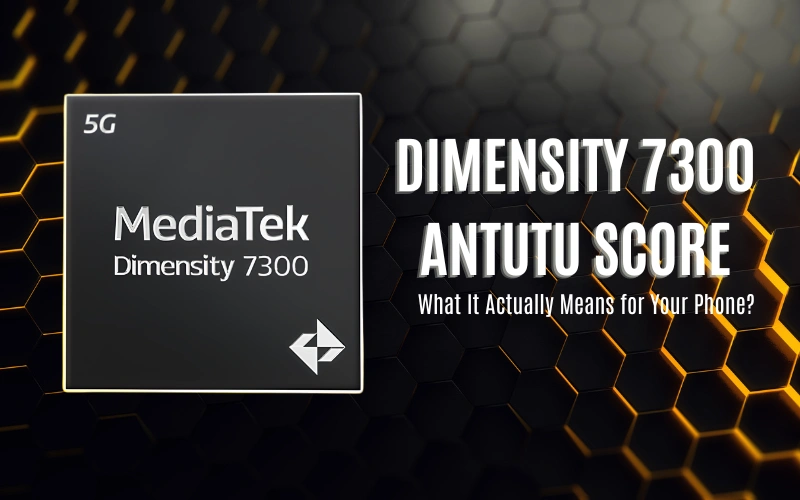
The Dimensity 7300 Antutu Score typically lands somewhere between 650,000 and 880,000 points on Antutu v10, depending on the phone brand, cooling design, and software tuning — with special variants like the Pro and Max pushing closer to 900,000 or higher.
Disclaimer: This article is compiled from multiple independent benchmark databases, tech publication reviews, and manufacturer listings. Benchmark numbers can change slightly with software updates, Antutu app versions, and individual phone tuning, so treat every figure here as a reliable estimate rather than a fixed, permanent number. Where a source looked unreliable or unverifiable (such as anonymous blog posts with no testing methodology), we’ve left it out or flagged it clearly.
Quick Stats Table: Dimensity 7300 at a Glance
| Detail | Information |
|---|---|
| Chipset Name | MediaTek Dimensity 7300 |
| Launch Date | June 18, 2024 |
| Manufacturing Process | 4nm |
| CPU | 4x Cortex-A78 (up to 2.5GHz) + 4x Cortex-A55 (up to 2.0GHz) |
| GPU | Mali-G615 MP2 (some sources list MC2) |
| Segment | Mid-range, efficiency-focused |
| Dimensity 7300 Antutu Score (typical range) | 650,000 – 880,000 (Antutu v10) |
| Geekbench 6 Single-Core | Around 1,000 – 1,026 |
| Geekbench 6 Multi-Core | Around 2,780 – 2,932 |
| Known Variants | Dimensity 7300, 7300e, 7300 Pro, 7300 Max, 7300 Ultra |
| Common Phones | CMF Phone 1, CMF Phone 2 Pro, Vivo T4x, ZTE Nubia Flip 2, Ulefone Armor 33 Pro, POCO X7 (Ultra variant) |
Introduction: Why Everyone’s Asking About the Dimensity 7300 Antutu Score
Here’s the thing about buying a mid-range phone in 2026 — the spec sheet alone doesn’t tell you much anymore. Every brand throws around fancy words like “5G-ready” and “AI-powered,” but the one number that actually tells you how smooth your phone will feel is the benchmark score. And when it comes to MediaTek’s popular mid-range chip, that means digging into the Dimensity 7300 Antutu Score.
If you’ve been shopping around and keep seeing this chip pop up in phones like the CMF Phone 1, Vivo T4x, or even a few gaming-focused budget phones, you’re probably wondering: is the Dimensity 7300 Antutu Score actually good, or is it just marketing noise? Good news — we pulled numbers from several independent testing labs, compared them side by side, and we’re laying it all out here in plain, simple language about the MediaTek Dimensity 7300. No confusing tech jargon, just honest numbers and what they actually mean for your daily phone use.
What Is Antutu, and Why Does the Score Matter?
Before jumping into the actual Dimensity 7300 Antutu Score, let’s quickly cover what Antutu even is, for anyone who’s new to this. Antutu is one of the most widely used benchmarking apps for smartphones. It runs your phone through a series of tests covering four main areas: the CPU (the brain that handles tasks), the GPU (which handles graphics and gaming), memory (how fast your phone can access data), and UX (a simulation of everyday tasks like scrolling and app switching).
Once all four tests finish, Antutu adds everything up into one big number — and that’s the total score you see floating around online. A higher number generally means a snappier phone, but it’s not the whole story. Two phones with the identical MediaTek Dimensity 7300 can post very different Antutu scores depending on cooling, RAM speed, and how the manufacturer tunes the software. That’s exactly why you’ll see some variation when comparing the Dimensity 7300 Antutu Score across different devices.
The Real Dimensity 7300 Antutu Score: What Testers Actually Found
This is the part you came for. We rounded up test results from multiple independent sources, and here’s what they found when running the chip through Antutu v10:
| Testing Source | Device Tested | Total Antutu Score |
|---|---|---|
| Gizmochina | CMF Phone (1) | 646,742 |
| Unite4buy database | General reference unit | 651,448 |
| 91Mobiles | Reference device (vs. Snapdragon 7 Gen 1) | 702,347 |
| Beebom | Vivo T4x | 871,785 |
| NanoReview | Aggregated user submissions | 877,641 |
Note (needs independent verification): Some online sources, particularly a few blog-style listicles, mention scores as high as 780,000–810,000 for specific “Pro” phone models without a transparent testing methodology. We’re flagging these because they don’t clearly explain testing conditions, and readers should treat such numbers cautiously until confirmed by a recognized benchmarking database like Antutu’s official rankings, NanoReview, or a known tech publication.
MediaTek Dimensity 7300 Antutu Score by Sub-Score (CPU, GPU, Memory, UX)
Total scores are useful, but breaking the MediaTek Dimensity 7300 Antutu Score into its four parts tells a much more interesting story. Using the Gizmochina test as our reference point, here’s how the MediaTek Dimensity 7300 Antutu Score splits up:
| Category | Sub-Score | What It Tells You |
|---|---|---|
| CPU | 190,224 | Strong day-to-day task handling |
| GPU | 147,566 | Where the chip is noticeably weaker |
| Memory | 144,435 | Solid, average data access speed |
| UX | 164,514 | Smooth scrolling and app switching |
Dimensity 7300 Variants: Not All Chips Are Created Equal
Here’s something a lot of buyers miss, and it’s honestly one of the sneakier parts of phone shopping. MediaTek didn’t just release one Dimensity 7300 — there are several variants floating around, and each one posts a different 7300 Antutu Score. Mixing these up is probably the single biggest reason people get confused when comparing numbers online. A quick glance at the table below shows just how much the 7300 Antutu Score can shift between variants.
| Variant | Launch | GPU | Typical Antutu Score |
|---|---|---|---|
| Dimensity 7300 (base) | June 2024 | Mali-G615 MP2 | 646,000 – 880,000 |
| Dimensity 7300e | Later refresh | Mali-G610 MC2 (same CPU) | Generally similar to base, GPU differs |
| Dimensity 7300 Pro | July 2025 | Improved GPU tuning | Around 907,685 (91Mobiles) |
| Dimensity 7300 Max | June 2026 | Higher clocked variant | Around 983,589 (91Mobiles) |
| Dimensity 7300 Ultra | Marketed on select devices | Different branding used by some retailers | Reported around 1,000,000, needs independent verification |
How Does the Dimensity 7300 Antutu Score Compare to Rival Chips?
Numbers only mean something when you have something to compare them to. Here’s how the chip stacks up against a few chips it commonly competes against in the mid-range market:
| Chip | Typical Antutu Score | Segment |
|---|---|---|
| MediaTek Dimensity 7300 | 650,000 – 880,000 | Mid-range |
| Qualcomm Snapdragon 7 Gen 1 | Around 584,312 | Mid-range |
| Qualcomm Snapdragon 865 Plus (older flagship) | Around 647,884 | Older flagship |
| Dimensity 7200 Pro (predecessor) | Higher GPU sub-scores reported, similar CPU tier | Mid-range |
Based on this comparison, the base Dimensity 7300 Antutu Score comfortably beats the Snapdragon 7 Gen 1 and even edges past an older flagship like the Snapdragon 865 Plus in raw numbers. That’s a genuinely impressive achievement for a mid-range chip, and it explains why so many budget and mid-tier phone makers picked it up quickly after launch.
Gaming Performance: Does the Antutu Score Tell the Whole Story?
If gaming is a priority for you, the total Dimensity 7300 Antutu Score alone won’t give you the full picture, because that number blends CPU, GPU, memory, and UX together. Reviewers who ran dedicated GPU stress tests, like 3DMark Wild Life, found the chip delivers excellent thermal stability (often above 98%), meaning your frame rate won’t crash after ten minutes of gaming. However, the actual peak performance ceiling is fairly low, with best loop scores sitting around 3,100–3,140 in most tests.
In plain English: this chip won’t drop frames or overheat easily, but it also won’t push high frame rates in graphically demanding games like Genshin Impact or Diablo Immortal. It’s built for stability over raw speed, which honestly makes sense for a mid-range, efficiency-focused chip aimed at everyday users rather than dedicated gamers.
Real-World Use: What the Dimensity 7300 Antutu Score Actually Feels Like
Numbers on a screen are one thing, but how does this translate to actually using the phone? Based on multiple hands-on reviews, phones running this chip handle everyday tasks — messaging, social media, video calls, casual browsing, and light multitasking — smoothly and without noticeable lag. Web browsing tests (Speedometer benchmark) scored a modest but usable 8.40 points, suggesting pages load reasonably fast, though very complex or script-heavy websites might take a moment longer than on a flagship phone.
Battery efficiency is another strong point tied to this chip’s design. Because it’s built with an efficiency-first mindset rather than chasing peak performance numbers, phones with the Dimensity 7300 tend to sip battery gently during regular use, which is a genuine win for anyone who hates charging their phone twice a day.
Conclusion: Is the Dimensity 7300 Antutu Score Actually Good?
Let’s bring it all together. The Dimensity 7300 Antutu Score typically falls between 650,000 and 880,000 points, depending on the exact phone and testing conditions, with the CPU consistently being the strongest part of the package and the GPU trailing behind. This full MediaTek Dimensity 7300 Antutu Score picture matters more than any single headline figure. Special variants like the Pro, Max, and reportedly Ultra push those numbers higher, sometimes close to or past 900,000–1,000,000, though those higher figures deserve a slightly more cautious eye until verified across more independent sources.
Frequently Asked Questions
Q1. What is a good Dimensity 7300 Antutu Score?
Based on multiple independent tests, anything between 650,000 and 880,000 on Antutu v10 is considered normal and healthy for the base MediaTek Dimensity 7300. Scores below that range on a brand-new phone might suggest thermal throttling or software issues worth investigating.
Q2. Why do different phones show different Dimensity 7300 Antutu Score results?
Even with the identical chip, factors like cooling design, RAM speed, software optimization, and the exact chip variant (base, Pro, Max) can all shift the final number, sometimes by a wide margin.
Q3. Is the Dimensity 7300 good for gaming?
It handles casual and mid-level gaming well, with excellent thermal stability, but its GPU sub-score is comparatively weaker, so heavy, graphics-intensive titles at high settings may struggle.
Q4. How does the MediaTek Dimensity 7300 Antutu Score compare to Snapdragon chips?
The MediaTek Dimensity 7300 generally outperforms the Snapdragon 7 Gen 1 and even edges past the older Snapdragon 865 Plus flagship in raw Antutu numbers, making it a strong pick in its price segment.
Q5. What’s the difference between the Dimensity 7300 and the 7300 Pro or Max?
The Pro and Max variants are refined or upgraded versions of the base chip, typically scoring higher on Antutu (around 900,000 and 980,000 respectively, based on available listings), thanks to tuning and clock speed differences.
Q6. Does a higher Antutu score always mean a better phone?
Not entirely. Antutu measures raw hardware performance, but real-world experience also depends on software optimization, display quality, battery life, and how well the manufacturer tunes the phone overall.
Thank you for reading. If you enjoyed this, check out our previous blog post: Vivo T4x Antutu Score.
For SEO & Website Analysis Tools insights and official testing resources, visit the official website: Tools by Alaikas.