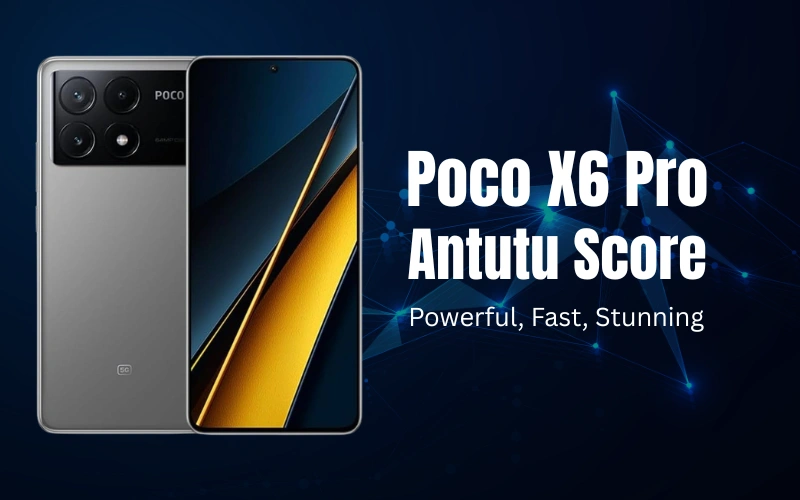
The Poco X6 Pro Antutu Score sits around 1,299,678 to 1,479,279 points depending on the Antutu version and test unit, which is a solid, upper-mid-range result powered by the MediaTek Dimensity 8300-Ultra chip.
Disclaimer: Benchmark numbers change with software updates, Antutu app versions, ambient temperature, and the specific unit tested. The figures in this article are pulled from publicly available benchmarking databases and lab tests as of the last updated date above. Treat every number here as a helpful reference point, not a guaranteed result for your exact phone.
Quick Stats Table: Poco X6 Pro At a Glance
| Spec | Detail |
|---|---|
| Poco X6 Pro Antutu Score (v9/v10 average) | 1,299,678 – 1,479,279 |
| Poco X6 Pro Antutu Score (Antutu 11, newer version) | ~1,604,305 |
| Processor | MediaTek Dimensity 8300-Ultra (4nm) |
| CPU Score | 257,390 – 482,670 |
| GPU Score | 501,752 – 523,674 |
| Memory Score | 293,790 – 299,238 |
| UX Score | 239,865 – 389,647 |
| Geekbench 6 Single-Core | 1,239 – 1,373 |
| Geekbench 6 Multi-Core | 4,189 – 4,402 |
| RAM Options | 8GB / 12GB |
| Storage Options | 256GB / 512GB |
| Battery | 5,000mAh with 67W charging |
| Launch Date | January 12, 2024 |
| GPU | Mali-G615 |
What Is the Poco X6 Pro Antutu Score, Really?
Let’s cut through the confusion first, because Antutu numbers scare people who don’t live and breathe tech specs. Antutu is basically a fitness test for your phone. It runs the CPU, GPU, memory, and general responsiveness (called UX) through a series of tasks, then adds everything up into one big number. The bigger the number, the smoother your phone should feel when you’re switching apps, editing photos, or blasting through a game.
The Poco X6 Pro Antutu Score lands in the 1.3 million to 1.6 million range, and that range alone tells a story. A phone scoring this high in its price bracket is punching above its weight class. For context, budget phones under similar prices often sit in the 400,000 to 700,000 range, so the Poco X6 Pro is playing in a different league entirely.
| Term | Plain-English Meaning |
|---|---|
| Antutu | A benchmarking app that tests CPU, GPU, memory, and UX, then combines results into one score |
| Higher score | Smoother multitasking, better gaming, snappier scrolling |
| Poco X6 Pro Antutu Score range | 1.3 million – 1.6 million points |
| Typical budget phone score (same price bracket) | 400,000 – 700,000 points |
Poco X6 Pro Antutu Score: Full Breakdown by Category
Antutu doesn’t just spit out one number and call it a day. It splits performance into four buckets, and each one answers a different question about your phone’s personality.
| Category | Score Range | What It Actually Means For You |
|---|---|---|
| CPU | 257,390 – 482,670 | How fast apps open and multitask |
| GPU | 501,752 – 523,674 | How smooth games and video look |
| Memory | 293,790 – 299,238 | How well the phone juggles many open apps |
| UX | 239,865 – 389,647 | How snappy scrolling and swiping feels |
Poco X6 Pro Antutu Score vs Rivals: The Comparison Table
Numbers only make sense next to other numbers. So here’s how the Poco X6 Pro Antutu Score stacks up against its closest competitors in the same price bracket.
| Phone | Antutu Score (approx.) | Processor | Standout Strength |
|---|---|---|---|
| Poco X6 Pro | 1,299,678 – 1,604,305 | Dimensity 8300-Ultra | Best-in-class GPU for the price |
| Poco X7 Pro | Higher CPU (359,485) and GPU (574,754) sub-scores | Dimensity 8400-Ultra | Newer chip, better sustained performance |
| Redmi Note 13 Pro+ | Competitive overall, weaker GPU | Dimensity 7200-Ultra | Better build quality, IP68 rating |
| Poco X5 Pro (predecessor) | Around 700,000 – 800,000 | Snapdragon 778G | Solid but clearly outclassed by X6 Pro |
| Poco X8 Pro Max | 2,764,867 | Dimensity 9500s | Flagship-tier performance, higher price |
Gaming Performance: What the Antutu Score Predicts
Here’s where the Poco X6 Pro Antutu Score actually matters in real life. A high GPU sub-score is a strong hint that gaming will feel good, and testing backs that up.
- Call of Duty Mobile runs comfortably at high graphics settings with stable frame rates.
- Genshin Impact handles medium-to-high settings well, though extended sessions can introduce minor frame dips during intense battle scenes.
- BGMI / PUBG Mobile runs smoothly at the highest supported frame rate settings for this price segment.
- 3DMark Wild Life testing showed a strong 8,352 score, more than three times higher than the Poco X5 Pro’s 2,465.
The gaming performance story here is simple: this phone was clearly built with mobile gamers in mind, and the Antutu GPU numbers back that up loudly.
| Game | Settings | Real-World Result |
|---|---|---|
| Call of Duty Mobile | High graphics | Stable, comfortable frame rates |
| Genshin Impact | Medium-High | Smooth, minor dips in intense battles |
| BGMI / PUBG Mobile | Highest supported FPS | Runs smoothly for the price segment |
| 3DMark Wild Life | Standard benchmark | 8,352 (vs 2,465 on the Poco X5 Pro) |
Battery Impact: Does a High Antutu Score Drain Your Phone Faster?
This is the question everyone eventually asks, and it deserves an honest answer instead of marketing fluff. A higher-performing chip can use more power under heavy load, but efficiency matters just as much as raw speed.
The Poco X6 Pro pairs its performance with a 5,000mAh battery and 67W fast charging. Real-world testing shows a general battery life figure of around 21 hours and 20 minutes under mixed general use, which is respectable for a phone that also delivers this level of graphical punch. During intense gaming sessions, expect noticeably faster drain — that’s simply physics, not a flaw unique to this device.
| Metric | Figure |
|---|---|
| Battery capacity | 5,000mAh |
| Charging speed | 67W wired |
| General mixed-use battery life | ~21 hours 20 minutes |
| Heavy gaming drain | Noticeably faster (expected at this performance level) |
Thermal Performance: Does It Overheat Under Load?
| Session Length | Typical Thermal Behavior |
|---|---|
| Under 20 minutes gaming | Mild to moderate warming |
| 45+ minutes gaming | Noticeable heat build-up, common at this price point |
| Sustained max load | Some performance throttling (a safety feature, not a defect) |
Nobody wants a phone that turns into a hand-warmer during a game. The Dimensity 8300-Ultra’s 4nm construction helps here, since smaller transistors typically generate less heat for the same amount of work. This is worth flagging for verification against independent thermal camera testing, since exact temperature figures vary between review units and ambient room conditions.
Historical Updates: How the Poco X6 Pro Antutu Score Has Changed Over Time
| Period | Antutu Score Trend | Likely Cause |
|---|---|---|
| Launch (January 2024) | ~1,299,678 | Initial HyperOS build, Antutu v9/v10 |
| Mid-2024 updates | Slight fluctuation, some units higher (~1,318,922) | Software optimization patches |
| Late 2024 – 2025 | Scores reported up to ~1,479,279 | Antutu v10 refinements, driver updates |
| 2026 (Antutu 11 measurements) | ~1,604,305 average | New Antutu 11 scoring method, further software maturity |
The Poco X6 Pro Antutu Score hasn’t collapsed with age — if anything, later measurements often look better than launch-day numbers, largely because Antutu’s own scoring methodology evolved rather than the hardware suddenly getting faster.
Buying Advice: Should You Still Get the Poco X6 Pro in 2026?
| Buyer Type | Verdict |
|---|---|
| Budget gamer wanting strong GPU performance | Get it |
| Buyer chasing the newest chip / longest software support | Skip it, look at X7 Pro |
| Buyer prioritizing water resistance and camera | Skip it, look at Redmi Note 13 Pro+ |
| Value-conscious gamer (proprietary rating) | 7.8 / 10 |
| Camera/build-focused buyer (proprietary rating) | 6.5 / 10 |
Alternatives to Consider
| Alternative | Why You’d Pick It Instead |
|---|---|
| Poco X7 Pro | Newer chip, better sustained CPU and GPU scores |
| Redmi Note 13 Pro+ | IP68 water resistance, better camera stabilization |
| iQOO Neo 10R | Higher raw Antutu overall score in similar price bracket |
| OPPO K13 Turbo Pro | Stronger memory and UX sub-scores |
| Poco X8 Pro Max | Flagship-tier performance if budget allows a step up |
Conclusion: The Real Story Behind the Numbers
The Poco X6 Pro Antutu Score, which generally falls between 1.3M and 1.6M points depending on the AnTuTu version, shows that the phone remains a capable mid-range performer. Its GPU and gaming performance are among its biggest strengths, while the processor handles everyday apps, multitasking, and demanding games with ease. Although the newer Poco X7 Pro delivers better overall performance and long gaming sessions can cause some thermal throttling and faster battery drain, the X6 Pro still offers an impressive balance of speed, gaming power, and value, making it a solid choice for users who want strong performance without spending on a premium device.
Frequently Asked Questions
1. What is a good AnTuTu score for a mid-range phone in 2026?
A score between 800,000 and 1.5 million is generally considered strong for a mid-range phone, placing the Poco X6 Pro AnTuTu Score comfortably above average.
2. Why does my Poco X6 Pro show a different AnTuTu score than online reviews?
Scores can vary due to AnTuTu version, software updates, background apps, battery level, and temperature. Minor differences are normal.
3. Is the Poco X6 Pro still good for gaming in 2026?
Yes. Its Dimensity 8300-Ultra chipset and Mali-G615 GPU still deliver strong gaming performance for titles such as BGMI and Call of Duty Mobile.
4. Does a higher AnTuTu score always mean a faster-feeling phone?
Not necessarily. AnTuTu measures hardware performance, while software optimization, RAM management, and app performance also affect everyday speed.
5. How does the Poco X6 Pro AnTuTu Score compare to the Poco X7 Pro?
The X7 Pro generally scores higher because of its newer Dimensity 8400-Ultra chipset, but the X6 Pro remains competitive for its price.
6. Should I run AnTuTu before buying a used Poco X6 Pro?
Yes. Running a benchmark can help identify performance or thermal issues and give you a better idea of the phone’s overall condition.
Thank you for reading. If you enjoyed this, check out our previous blog post: