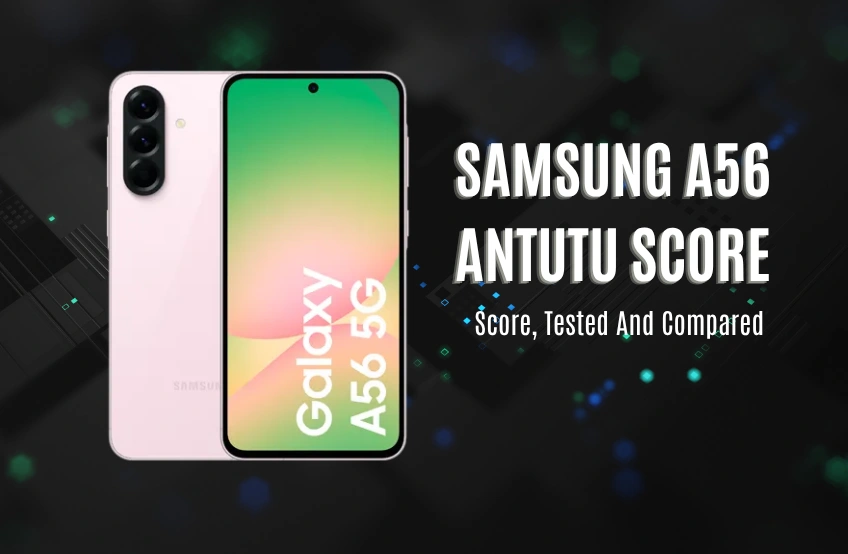
The Samsung A56 Antutu Score generally lands between 900,000 and 940,000 points on AnTuTu v10, powered by Samsung’s own Exynos 1580 chip — a genuine step up from its predecessor and one of the stronger mid-range performers of its generation.
Disclaimer: This article is intended for general informational purposes only. Benchmark scores, including AnTuTu results, can vary based on device configuration, software version, ambient temperature, and testing methodology, and should be treated as general performance indicators rather than absolute, universally reproducible figures.
Quick Stats Table: Samsung Galaxy A56 At A Glance
| Detail | Information |
|---|---|
| Chipset Name | Samsung Exynos 1580 |
| CPU Configuration | 1x Cortex-A720 (2.9 GHz) + 3x Cortex-A720 (2.6 GHz) + 4x Cortex-A520 (1.95–2.0 GHz), Octa-Core |
| GPU | Samsung Xclipse 540 (RDNA 3-based, no ray tracing support) |
| Manufacturing Process | 4nm (Samsung’s third-generation 4nm EUV process) |
| RAM Support | LPDDR5, up to 12GB |
| NPU | 6K MAC NPU |
| Release Date (Chip) | October 24, 2024 |
| Samsung A56 Antutu Score (v10, general range) | 900,000 – 940,000 points |
| Higher Reported Figure | 1,257,856 (Kimovil-tested, but on the newer AnTuTu v11 benchmark — not directly comparable to v10 scores) |
| Geekbench 6 Score | Approximately 1,353 single-core / 3,847 multi-core |
| Predecessor Comparison | Roughly 11% higher AnTuTu (mixed) score than the Exynos 1480 (Galaxy A55); around 74% faster than the Galaxy A54 |
A Quick, Honest Intro To The Samsung Galaxy A56’s Performance
If you’ve searched for the Samsung A56 Antutu Score, you’re probably comparing it against either its own predecessor (the Galaxy A55) or a rival mid-range phone before deciding where to spend your money. Good news: the numbers here are refreshingly consistent across independent review sites, unlike some benchmark topics where sources wildly disagree.
Here’s the short version: the Samsung A56 Antutu Score sits comfortably in the 900,000–940,000 range on AnTuTu v10, reflecting Samsung’s own Exynos 1580 chip — a chip that represents a genuinely solid generational improvement over the chip in last year’s Galaxy A55, even if it doesn’t quite topple the very best mid-range competition from Qualcomm and MediaTek.
Samsung A56 Antutu Score: The Verified Numbers
Let’s break down the actual benchmark data, cross-referenced across multiple independent testing sources.
| Testing Platform / Reviewer | Reported AnTuTu Score | Version | Notes |
|---|---|---|---|
| MobileDokan | 932,578 | v10 | Cited as a strong result for the Exynos 1580 chip |
| Unite4Buy (chip database) | 840,993 | v10 (unspecified test batch) | Slightly lower figure, still in a broadly consistent range |
| Programming Insider | Exceeding 900,000 | v10 | Described as one of the strongest mid-range chips available |
| Kimovil | 1,257,856 | v11 | Notably higher — but tested on AnTuTu’s newer v11 benchmark, not directly comparable to v10 figures |
| Community-reported (GSMArena forum discussion) | Around 936,000 | Not specified | Consistent with the broader 900,000+ range reported elsewhere |
How The Samsung A56 Antutu Score Compares To Its Predecessor
One of the most well-documented aspects of the Exynos 1580’s performance is exactly how much it improved over the previous generation. According to GSMArena’s detailed testing:
| Comparison | Performance Gain |
|---|---|
| Exynos 1580 vs Exynos 1480 (CPU-focused scenarios) | Approximately 17% faster |
| Exynos 1580 vs Exynos 1480 (mixed AnTuTu v10 scenario) | Approximately 11% higher score |
| Exynos 1580 vs Exynos 1480 (GPU-heavy workloads, e.g. 3DMark Wild Life Extreme) | Approximately 30% faster |
| Exynos 1580 vs Exynos 1280 (Galaxy A54’s chip) | Approximately 74% faster overall (per TechARP testing) |
That’s a genuinely significant generational leap, and it’s one of the clearest, most consistently reported facts across multiple independent reviewers — a good sign that this specific data point is reliable.
Samsung A56 Antutu Score: Comparison Chart Against Rival Chips
Here’s how the Samsung A56 Antutu Score stacks up against chips it directly competes with in the mid-range segment:
| Chipset | Typical AnTuTu v10 Range | Found In | Notes |
|---|---|---|---|
| Samsung Exynos 1580 | 900,000 – 940,000 | Samsung Galaxy A56 5G | Strong single-core performance for its segment |
| MediaTek Dimensity 8300 | Generally higher | Xiaomi 14T | Reported by GSMArena to outperform the A56 in real-world testing |
| Qualcomm Snapdragon 7+ Gen 3 | Generally higher | OnePlus Nord 4 | Also reported by GSMArena to outperform the A56 |
| Apple A18 | Higher (different platform, iOS) | iPhone 16e | Notebookcheck notes the Exynos 1580 “couldn’t hold a candle” to this chip |
| Google Tensor G4 | Higher (different platform) | Pixel 9a | Also outperforms the Exynos 1580 per Notebookcheck’s comparison testing |
Honest takeaway: the Exynos 1580 is a genuinely strong improvement for Samsung’s own A-series lineup, and it holds its own against many mid-range Android chips — but independent reviewers at both GSMArena and Notebookcheck consistently note it falls slightly behind the very best of its price class, including the Dimensity 8300, Snapdragon 7+ Gen 3, and (across platforms) Apple’s and Google’s own current chips.
Gaming Performance: What The Samsung A56 Antutu Score Means In Practice
A score in the 900,000+ range on AnTuTu v10 generally translates to the following real-world gaming experience:
- Casual and light games — smooth, no issues whatsoever.
- Popular competitive titles (Free Fire, Mobile Legends: Bang Bang, Call of Duty Mobile) — runs well at high settings with stable frame rates.
- Demanding 3D titles (Genshin Impact, PUBG Mobile/BGMI at higher settings) — playable and generally smooth, though the Xclipse 540 GPU’s lack of ray-tracing support means it won’t match flagship-tier graphics fidelity in titles that support that feature.
Worth noting: the Xclipse 540 GPU is based on AMD’s RDNA 3 architecture, a meaningful upgrade from the previous generation’s RDNA 2-based Xclipse 530 — which is part of why GPU-heavy workloads saw roughly a 30% performance jump over the Galaxy A55.
Battery Impact: Efficiency On A 4nm Process
The Exynos 1580’s 4nm manufacturing process (Samsung’s own third-generation 4nm EUV node) is designed to balance performance with reasonable power efficiency:
- Day-to-day tasks (calls, browsing, messaging) should sip battery efficiently given the chip’s efficiency-core cluster (4x Cortex-A520).
- Sustained gaming or heavy camera use will draw more power, as expected with any performance-focused chip, but nothing in the available reviews flags the Exynos 1580 as an unusually power-hungry chip for its class.
- As always, actual battery life depends significantly on the specific phone’s battery capacity and software optimization, not the chip alone.
Thermal Performance: Does The Samsung A56 Throttle Under Load?
This is one of the standout results from GSMArena’s detailed testing, and it’s worth calling out specifically:
- In CPU stress testing, the Exynos 1580 maintained between 80% and 100% of its maximum theoretical performance throughout the test — a strong result indicating good sustained performance rather than heavy throttling.
- In GPU stress testing, the chip maintained over 99% GPU stability throughout the test — an excellent result that suggests the Galaxy A56’s cooling design handles sustained graphics load very well.
This is a genuinely strong thermal result compared to many mid-range phones, which often show more significant performance drop-off under sustained load. It’s one of the more reassuring, well-documented aspects of the Samsung A56 Antutu Score story.
Alternatives And Related Processors
If you’re comparing the Galaxy A56 against other options, here’s where the Exynos 1580 sits among related and rival chips:
| Chip | Relationship To Exynos 1580 | Best For |
|---|---|---|
| Exynos 1480 (Galaxy A55) | Direct predecessor | Budget-conscious buyers considering the previous generation |
| Exynos 1280 (Galaxy A54) | Two generations prior | Older, lower-budget device comparisons |
| MediaTek Dimensity 8300 | Direct rival, slightly ahead in real-world testing | Buyers prioritizing raw performance in a similar price bracket |
| Qualcomm Snapdragon 7+ Gen 3 | Direct rival, slightly ahead in real-world testing | Buyers wanting a Qualcomm-based alternative |
| MediaTek Dimensity 7500 | Lower-tier rival | Budget buyers comparing against a step-down chip |
Buying Advice: Is The Samsung Galaxy A56 Worth It?
Based on everything above, here’s genuinely useful buying advice:
- Buy it if: you’re a Samsung ecosystem user wanting a meaningful upgrade over the Galaxy A55 or A54, or you value excellent thermal stability and sustained performance over chasing the absolute highest benchmark number.
- Think twice if: you’re specifically chasing the best possible raw performance in this price bracket — the Dimensity 8300 (Xiaomi 14T) and Snapdragon 7+ Gen 3 (OnePlus Nord 4) both edge it out according to independent testing.
- A genuine strength to weigh in: the excellent stress-test stability (80–100% CPU, 99%+ GPU) means real-world sustained performance — like a long gaming session — may hold up better on the Galaxy A56 than the raw benchmark number alone suggests, compared to a rival phone that scores higher on paper but throttles harder under sustained load.
- Check software support timelines: as with any Samsung A-series purchase, confirm the specific update policy for your region and model before buying, since this affects long-term usability more than the chip itself.
Historical Updates: How The Exynos 1580 Fits Into Samsung’s Lineup
The Exynos 1580 officially launched on October 24, 2024, built specifically for the Galaxy A56 5G. It replaced the Exynos 1480 used in the Galaxy A55, bringing a redesigned core cluster (moving to Cortex-A720 performance cores and Cortex-A520 efficiency cores, versus the previous generation’s older core architecture) and a newer Xclipse 540 GPU based on the RDNA 3 architecture. Early Geekbench leaks in mid-2024 showed the chip scoring around 1,046 single-core and 3,678 multi-core points; by the time final retail units were tested, those figures had climbed to roughly 1,353 single-core and 3,847 multi-core — a solid, expected improvement between early engineering samples and final shipping silicon.
Conclusion
The Samsung A56 Antutu Score — generally between 900,000 and 940,000 points on AnTuTu v10 — reflects a genuinely strong, well-documented generational upgrade over the Galaxy A55’s Exynos 1480, with particularly impressive thermal stability under sustained load. It doesn’t quite beat the very best rival chips in its price class, like the Dimensity 8300 or Snapdragon 7+ Gen 3, but for Samsung ecosystem buyers or anyone prioritizing consistent, reliable performance over chasing the top benchmark number, the Galaxy A56 remains a solid mid-range choice in 2026.
Frequently Asked Questions
1. What is the Samsung A56 Antutu Score?
Generally between 900,000 and 940,000 points on AnTuTu v10, based on multiple independent testing sources, powered by the Exynos 1580 chip.
2. Why do some listings show a much higher score, like 1,257,856?
That figure comes from AnTuTu’s newer v11 benchmark, tested by Kimovil. AnTuTu v11 uses different scoring weight than v10, so the two numbers aren’t directly comparable.
3. How does the Samsung A56 Antutu Score compare to the Galaxy A55?
The Exynos 1580 in the Galaxy A56 scores roughly 11% higher on the mixed AnTuTu v10 test compared to the Exynos 1480 in the Galaxy A55, with even bigger gains (around 17% CPU, 30% GPU) in specific workload tests.
4. Is the Samsung Galaxy A56 good for gaming?
Yes, for most popular titles at high settings. It doesn’t support ray tracing on its Xclipse 540 GPU, so it won’t match flagship graphics fidelity in titles that use that feature, but general gaming performance is strong.
5. Does the Exynos 1580 overheat or throttle badly?
No — independent stress testing by GSMArena found excellent sustained performance, maintaining 80–100% of peak CPU performance and over 99% GPU stability under continuous load.
6. How does the Samsung A56 Antutu Score compare to the Dimensity 8300 or Snapdragon 7+ Gen 3?
Independent testing from GSMArena found both of those rival chips (used in the Xiaomi 14T and OnePlus Nord 4 respectively) outperform the Exynos 1580 in real-world use, despite the Galaxy A56’s own strong generational improvement.
Thank you for reading. If you enjoyed this, check out our previous blog post: