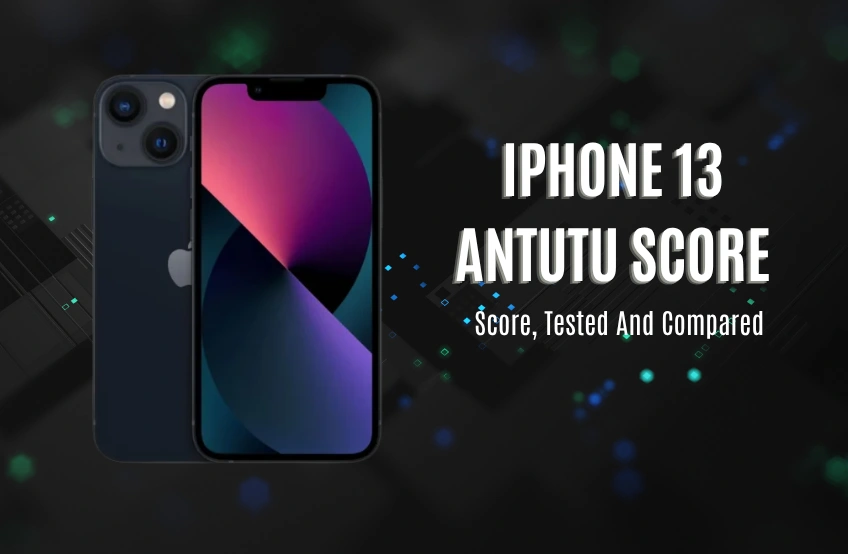
The iPhone 13 Antutu Score sits at approximately 1,256,049 points on AnTuTu v10, powered by Apple’s A15 Bionic chip, placing it ahead of roughly 87% of all smartphones tested on the platform, even years after its original release.
Disclaimer: This article is intended for general informational purposes only. Benchmark scores, including AnTuTu results, can vary based on device configuration, software version, ambient temperature, and testing methodology, and should be treated as general performance indicators rather than absolute, universally reproducible figures.
Quick Stats Table: iPhone 13 At A Glance
| Detail | Information |
|---|---|
| Chipset Name | Apple A15 Bionic |
| CPU Configuration | 2x Performance cores (“Avalanche/Firestorm”) up to 3.23 GHz + 4x Efficiency cores (“Blizzard/Icestorm”) up to 2.02 GHz |
| GPU | 4-core Apple-designed GPU (iPhone 13 and 13 mini); 5-core GPU on iPhone 13 Pro/Pro Max |
| Manufacturing Process | 5nm (TSMC) |
| Transistor Count | 15.8 billion |
| Release Date | September 2021 |
| iPhone 13 Antutu Score (v10) | 1,256,049 points (Kimovil-tested) |
| Highest Recorded A15 Bionic Score | 1,286,140 points (91mobiles-tested, likely a Pro/Pro Max configuration) |
| Geekbench 5 Score | 1,734 single-core / 4,818 multi-core |
| AnTuTu Percentile Ranking | Better than approximately 87% of tested smartphones |
| Devices Using This Chip | iPhone 13, iPhone 13 mini, iPhone 13 Pro, iPhone 13 Pro Max, iPhone SE (2022), iPad mini (2021) |
A Quick, Honest Intro To The iPhone 13’s Performance
If you’ve searched for the iPhone 13 Antutu Score, you’re probably one of two people: someone considering a secondhand or budget-priced iPhone 13 in 2026 and wondering if the performance still holds up, or someone comparing it against a newer Android phone before buying. Either way, here’s the encouraging news upfront: the A15 Bionic chip inside the iPhone 13 was so far ahead of its time in 2021 that it’s still genuinely competitive against many current mid-range and even some premium Android chips, five years on.
Here’s the short version: the iPhone 13 Antutu Score lands around 1,256,049 points on AnTuTu’s current v10 benchmark, a figure that places it ahead of the vast majority of smartphones ever tested on the platform. That’s a remarkable amount of staying power for a chip that’s now a few generations old.
iPhone 13 Antutu Score: The Verified Numbers
Let’s get into the actual benchmark data, sourced from independent testing platforms rather than marketing claims.
| Testing Platform | Reported AnTuTu Score | Version | Notes |
|---|---|---|---|
| Kimovil | 1,256,049 | v10 | Standard iPhone 13 (4-core GPU) |
| 91mobiles | 1,286,140 | v10 | Listed for A15 Bionic generally; likely reflects a Pro/Pro Max unit with the 5-core GPU |
| AnTuTu (original 2021 test, via Notebookcheck) | 839,675 | v9 (legacy) | iPhone 13 Pro, tested shortly after launch — not directly comparable to current v10 scores due to AnTuTu’s benchmark methodology changes |
Why The iPhone 13 Antutu Score Still Holds Up In 2026
A few genuine reasons the iPhone 13 Antutu Score remains impressive years after launch:
- Apple’s chip design advantage — Apple has consistently designed its A-series chips with a significant lead over most Android SoCs in single-core performance, and that gap took years for competitors to meaningfully close.
- Long software support — iOS updates continue to optimize performance on older A-series chips longer than most Android manufacturers support their own hardware, which helps sustain real-world (not just benchmark) performance.
- 5nm manufacturing efficiency — the A15 Bionic’s 5nm process was ahead of many competing chips at the time, contributing to both performance and efficiency gains that still hold up reasonably well against many current budget and mid-range chips.
iPhone 13 Antutu Score: Comparison Chart Against Other Chips
Here’s how the iPhone 13 Antutu Score stacks up against a mix of its original 2021 rivals and some newer chips it still competes with on the secondhand and budget market in 2026:
| Chipset | Typical AnTuTu v10 Score | Segment |
|---|---|---|
| Apple A15 Bionic (iPhone 13) | ~1,256,049 | Flagship (2021) |
| Samsung Exynos 2100 (Galaxy S21 series, 2021 rival) | Historically scored lower in Geekbench single-core vs A15 | Flagship (2021) |
| Qualcomm Snapdragon 888 (2021 rival) | Historically scored lower in Geekbench single-core vs A15 | Flagship (2021) |
| Snapdragon 685 (2026-era budget/mid-range) | Approximately 300,000 – 330,000 | Mid-range |
| Snapdragon 7 Gen 3 (2026-era mid-range/premium) | Generally higher than A15 in raw AnTuTu terms | Upper-mid-range |
| Apple A16 Bionic (iPhone 14 Pro successor chip) | Notebookcheck ranks it just above the A15 Bionic | Flagship (2022) |
Gaming Performance: What The iPhone 13 Antutu Score Means In Practice
A score over 1.2 million on AnTuTu v10 translates to a genuinely strong real-world gaming experience:
- Casual and 2D games — completely smooth, no compromises needed.
- Popular competitive titles (Free Fire, Mobile Legends: Bang Bang, Call of Duty Mobile) — runs comfortably at high settings, with stable frame rates even during intense scenes.
- Heavy 3D titles (Genshin Impact, PUBG Mobile/BGMI at max settings) — the A15 Bionic handles these titles well, though sustained long gaming sessions can trigger thermal throttling (more on that below), which is typical of any smartphone chip pushed hard for extended periods.
Notably, the iPhone 13 mini and standard iPhone 13 use a 4-core GPU, while the iPhone 13 Pro and Pro Max use a 5-core GPU — so if gaming is your top priority and you’re choosing between iPhone 13 variants specifically (new or secondhand), the Pro models will edge out the standard model in sustained graphics-heavy performance, even though they share the same CPU.
Battery Impact: Performance Without Draining Fast
The A15 Bionic was specifically praised at launch for combining strong performance with efficient power draw, and that reputation has held up:
- Everyday tasks (calls, browsing, messaging, social media) sip battery efficiently thanks to the chip’s 5nm process and well-optimized efficiency cores.
- Gaming and camera-intensive tasks will drain the battery faster, as with any smartphone, but the A15 Bionic is generally regarded as one of the more power-efficient flagship chips of its generation.
- Battery longevity in 2026 for any iPhone 13 unit (new old stock or secondhand) will depend heavily on battery health/cycle count at this point, since the phone is several years old — this is a bigger factor in real-world battery life today than the chip’s efficiency alone.
Thermal Performance: Does The iPhone 13 Throttle Under Load?
Thermal behavior directly affects sustained benchmark and gaming performance:
- Under short benchmark runs, the A15 Bionic performs at or near its peak, which is what produces the high iPhone 13 Antutu Score figures cited throughout this article.
- Under extended, heavy gaming sessions, like most smartphone chips, it will throttle to manage heat — this is normal behavior across the industry, not a defect specific to this chip.
- The Pro and Pro Max models, with slightly larger chassis and different internal thermal designs compared to the standard iPhone 13 and mini, have generally been reported to sustain peak performance a bit longer under extended load, though exact thermal behavior can vary by unit and ambient conditions.
Alternatives And Related Processors
If you’re weighing the iPhone 13 against other options in 2026, here’s where the A15 Bionic sits among related chips:
| Chip | Relationship To A15 Bionic | Best For |
|---|---|---|
| Apple A14 Bionic (iPhone 12 series) | Direct predecessor | Budget-conscious buyers wanting a slightly older, still-capable iPhone |
| Apple A16 Bionic (iPhone 14 Pro/Pro Max) | Direct successor, used in Pro models the following year | Buyers wanting a newer chip with a similar Apple ecosystem experience |
| Apple A17 Pro / A18 series | Multiple generations newer | Buyers prioritizing the latest raw performance |
| Snapdragon 8 Gen 1 (2022 flagship Android rival) | Contemporary-era Android flagship competitor | Android users wanting comparable era performance |
| Snapdragon 7 Gen 3 (2026-era mid-range Android chip) | Modern chip now competing with the A15 Bionic on the secondhand/budget market | Android buyers wanting new mid-range hardware over an older flagship iPhone |
Buying Advice: Is The iPhone 13 Worth It In 2026?
Given everything above, here’s genuinely useful buying advice rather than generic marketing language:
- Buy it if: you want strong day-to-day performance and reliable gaming capability at a lower price point than current-generation iPhones, and you’re comfortable buying a phone that’s a few years into its software support lifecycle.
- Check battery health first: since this phone is now several years old, always check the battery health percentage before buying secondhand — this affects real-world usability far more than the chip’s benchmark score at this point.
- Consider the Pro variants for gaming: if graphically intensive gaming is a priority, the 5-core GPU on the iPhone 13 Pro/Pro Max gives a real, if modest, edge over the standard iPhone 13 and mini.
- Compare against current mid-range Android chips: while the A15 Bionic still holds its own, some 2026-era mid-range Android chips (like the Snapdragon 7 Gen 3) now match or exceed it in raw AnTuTu terms — worth comparing directly if you’re chip-shopping rather than specifically wanting an iPhone.
Historical Updates: How The A15 Bionic Fits Into Apple’s Lineup
The A15 Bionic marked a more incremental CPU upgrade over the A14 Bionic compared to some previous year-over-year jumps, with Apple itself focusing marketing more heavily on GPU gains (30% for the standard 4-core GPU model, up to 50% for the 5-core GPU Pro models) rather than dramatic CPU improvements. It went on to power not just the iPhone 13 lineup, but also the iPhone SE (2022) and the iPad mini (2021), giving it one of the longer deployment runs of any recent Apple chip — a sign of how well-regarded its balance of performance and efficiency was at the time. It remains, per independent benchmark trackers, ranked just below the succeeding A16 Bionic in overall performance terms, which says a lot about how future-proof this chip turned out to be.
Conclusion
The iPhone 13 Antutu Score — around 1,256,049 points on AnTuTu v10 — is a genuine testament to how far ahead the A15 Bionic chip was when it launched in 2021. Years later, it still comfortably handles demanding games and everyday tasks, and it only recently started facing real competition from newer mid-range Android chips. If you’re considering an iPhone 13 in 2026, whether new-old-stock or secondhand, the chip itself is not the bottleneck to worry about — battery health and software update timelines matter far more at this stage of the phone’s life.
Frequently Asked Questions
1. What is the iPhone 13 Antutu Score?
Approximately 1,256,049 points on AnTuTu v10, based on independent testing, placing it ahead of roughly 87% of all tested smartphones.
2. Is the iPhone 13 Antutu Score still good in 2026?
Yes. Despite being several years old, the A15 Bionic chip remains competitive with many current mid-range and even some premium Android chips.
3. Why do some articles show a much lower iPhone 13 Antutu Score, like 839,675?
That figure comes from AnTuTu’s older v9 benchmark used around the phone’s 2021 launch. AnTuTu significantly changed its scoring methodology in v10, so scores from different versions aren’t directly comparable.
4. Does the iPhone 13 Pro have a different Antutu Score than the standard iPhone 13?
Both share the same A15 Bionic CPU, but the Pro and Pro Max use a 5-core GPU versus the standard model’s 4-core GPU, which can produce a somewhat higher overall score, particularly in graphics-heavy benchmark segments.
5. Is the iPhone 13 good for gaming?
Yes. It comfortably handles both casual and demanding 3D titles, with the Pro/Pro Max variants offering a slight edge in sustained graphics performance due to their extra GPU core.
Thank you for reading. If you enjoyed this, check out our previous blog post: