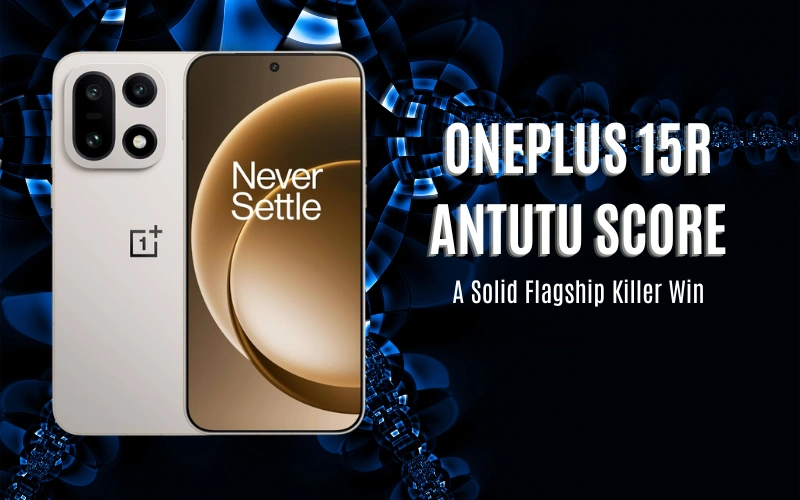
The OnePlus 15R AnTuTu Score averages around 3 million points, with test results ranging from roughly 2.95 million to 3.17 million depending on the run, software version, and cooling conditions.
Disclaimer: Benchmark scores, pricing, and specifications mentioned in this article are approximate and based on publicly available test data as of mid-2026. Actual results may vary by unit, region, and software version. Please verify current figures through official AnTuTu rankings or the retailer before making a purchase decision.
Quick Snapshot: OnePlus 15R At A Glance
| Detail | Information |
|---|---|
| Phone Name | OnePlus 15R |
| Launch Date | December 2025 |
| Chipset | Snapdragon 8 Gen 5 |
| Display | 6.83-inch |
| RAM Options | Up to 16 GB |
| Storage Options | Up to 512 GB |
| Battery | 7,400 mAh |
| Protection Glass | Corning Gorilla Glass 7i |
| OnePlus 15R AnTuTu Score | Approximately 2.95M – 3.17M (avg. ~3M) |
| Geekbench 6 Single-Core | Around 2,851 |
| Geekbench 6 Multi-Core | Around 9,363 |
| India Price (approx.) | ₹54,999 |
| Global Price (approx.) | $550 – $600 |
What Is AnTuTu And Why Should You Care?
Before we go further, let’s clear up something basic. AnTuTu is a benchmarking app that pushes a phone’s processor, graphics chip, memory, and overall responsiveness through a series of tests, then adds it all up into one big number. A higher number generally means a phone can handle heavier tasks — think intense gaming, multitasking, or editing — more smoothly.
Here’s the honest bit though: AnTuTu is not the only thing that decides if a phone feels fast in daily life. It’s a useful indicator, not a magic truth serum. Still, when you’re comparing two similarly priced phones, the OnePlus 15R AnTuTu Score gives you a fairly reliable starting point for judging raw power.
OnePlus 15R AnTuTu Score – The Actual Numbers
Let’s not dance around this. Multiple independent benchmarking sources have tested the OnePlus 15R, and here’s what they found:
| Source | Reported AnTuTu Score |
|---|---|
| 91mobiles | 2,957,229 |
| Kimovil | 3,081,506 |
| Nanoreview (average) | 3,039,097 |
| GSMArena (AnTuTu listing reference) | 3,168,069 |
| Independent hands-on review | “around 3 million” |
Breaking Down The Score By Category
AnTuTu doesn’t just spit out one number — it actually tests four separate areas. Here’s roughly how the OnePlus 15R performs across them, based on the 91mobiles test data:
| Test Category | Approximate Score |
|---|---|
| CPU | 913,640 |
| GPU | 973,083 |
| Memory | 913,640 |
| UX (User Experience) | 688,295 |
OnePlus 15R vs OnePlus 15: How Big Is The Gap?
This is probably the comparison most shoppers actually care about. Is the “R” variant really a big step down from the standard flagship?
| Model | Chipset | AnTuTu Score (approx.) |
|---|---|---|
| OnePlus 15R | Snapdragon 8 Gen 5 | ~3,000,000 – 3,170,000 |
| OnePlus 15 | Snapdragon 8 Elite Gen 5 | ~3,690,000 – 4,030,000 |
| OnePlus Turbo | Snapdragon 8s Gen 4 | ~2,610,000 |
The gap between the 15R and the standard 15 is real, sitting somewhere around 600,000 to 900,000 points depending on which source you trust. In plain terms: the standard OnePlus 15 is noticeably faster on paper, but the 15R still comfortably beats budget and mid-range chipsets like the one inside the OnePlus Turbo. If raw top-tier power is your only concern, the OnePlus 15 wins. If you want strong performance without paying full flagship price, the OnePlus 15R AnTuTu Score still puts it in a very respectable position.
OnePlus 15R vs OnePlus 13R: A Generation Later
Comparing a new phone to its direct predecessor always tells a useful story about real progress, not just marketing talk.
| Feature | OnePlus 13R | OnePlus 15R |
|---|---|---|
| Chipset | Snapdragon 8 Gen 3 (approx.) | Snapdragon 8 Gen 5 |
| Telephoto Camera | Included | Removed |
| Battery | Smaller | 7,400 mAh |
| AnTuTu Score | Lower generation-tier | ~3 million |
Related Processors Worth Knowing About
Since the OnePlus 15R runs on the Snapdragon 8 Gen 5, it’s worth understanding where that chip sits in Qualcomm’s current lineup:
- Snapdragon 8 Elite Gen 5 – the true top-tier chip, found in the standard OnePlus 15 and several rival flagships.
- Snapdragon 8 Gen 5 – the chip inside the OnePlus 15R, built for strong performance at a friendlier price.
- Snapdragon 8s Gen 4 – a step below, found in phones like the OnePlus Turbo.
Think of it like airline seating. The Elite Gen 5 is business class, the Gen 5 in the 15R is premium economy with surprisingly good legroom, and the 8s Gen 4 is standard economy — still gets you there, just without the extra perks.
Gaming Performance: Does The Score Translate To Smooth Gameplay?
Numbers are nice, but can this phone actually handle a long gaming session without turning into a hot potato? Based on 3DMark testing:
| Test | Score |
|---|---|
| Wild Life Extreme | 4,747 |
| Steel Nomad | 1,933 |
Thermal Performance: Keeping Its Cool
A high score means nothing if the phone overheats within ten minutes of intense use. OnePlus fitted the 15R with a 5,704 mm² Cryo-Velocity 3D vapor chamber — essentially a flat cooling system spread across a large internal surface area to pull heat away from the chip quickly.
In practical testing, this setup kept temperatures under control during extended gaming and benchmarking sessions, which explains why the phone’s scores stayed fairly consistent across multiple test rounds rather than dropping sharply after a few minutes, the way poorly-cooled phones often do.
Battery Impact: Does High Performance Drain The Battery Fast?
Here’s some genuinely good news. Despite delivering a strong OnePlus 15R AnTuTu Score, the phone doesn’t punish you with poor battery life. PCMark battery testing recorded a runtime of around 18 hours and 13 minutes under a mixed-use workload. Paired with the large 7,400 mAh battery, this suggests OnePlus has tuned the Snapdragon 8 Gen 5 chip for a sensible balance between speed and efficiency, rather than chasing benchmark numbers at the cost of screen-on time.
Historical Updates: How The Score Has Shifted Over Time
Benchmark numbers aren’t set in stone the day a phone launches. Software updates, AnTuTu app version changes, and driver optimizations can shift results over the following months. Based on available community reports, some users noted their personal OnePlus 15R AnTuTu Score changing slightly after a software update, which is a completely normal pattern across the smartphone industry — not unique to OnePlus. If you’re comparing your own device’s score against published figures, always check which AnTuTu version and software build was used, since even a minor mismatch can explain a few hundred thousand points of difference.
Common Misconceptions About The OnePlus 15R AnTuTu Score
Before we move on, let’s bust a few myths that tend to float around every time a new benchmark number goes viral.
Myth 1: A higher AnTuTu score always means a better phone. Not quite. The OnePlus 15R AnTuTu Score tells you about raw processing muscle, but it says nothing about camera quality, software smoothness, build quality, or how the phone feels in daily use. A phone with a slightly lower score but better software optimization can genuinely feel faster to use.
Myth 2: One test run gives you the “real” score. As we’ve already seen from the source comparison table above, results shift between runs. Judging a phone off a single screenshot floating around social media is a bit like judging a runner’s speed from one lucky sprint instead of an average across several races.
Myth 3: AnTuTu scores can’t be manipulated. This one deserves an honest mention. In the past, some manufacturers have been caught tuning software specifically to boost benchmark numbers rather than real-world performance. AnTuTu itself has pushed back against this by updating its testing methods regularly. It’s worth keeping this history in mind, and cross-checking the OnePlus 15R AnTuTu Score against independent reviewer testing rather than relying purely on manufacturer-provided numbers.
Myth 4: A 3 million score feels the same on every phone. Cooling design, software optimization, and even the display refresh rate can make two phones with near-identical AnTuTu numbers feel noticeably different in hand. This is exactly why this article also covers thermal and gaming stress-test data instead of stopping at the headline number.
Real-World Performance vs Benchmark Numbers
Here’s a fair question worth asking directly: does the OnePlus 15R AnTuTu Score actually match how the phone feels when you’re using it?
Based on available hands-on reviews, the answer leans toward yes, with a small asterisk. Reviewers consistently describe the phone as feeling quick during app switching, smooth during scrolling, and capable during gaming sessions without noticeable slowdown. That lines up well with a benchmark score sitting comfortably in flagship-adjacent territory.
The asterisk comes from the missing telephoto camera and the lack of eSIM support, mentioned earlier — reminders that a strong OnePlus 15R AnTuTu Score doesn’t automatically mean every single feature matches flagship-level expectations. Performance and feature completeness are two separate conversations, and it’s worth judging both before you decide this phone is “the one.”
OnePlus 15R Alternatives To Consider
If you’re shopping around and want to weigh your options before locking in the 15R, here are a few phones worth comparing:
| Alternative | Chipset | Notable Strength |
|---|---|---|
| OnePlus 15 | Snapdragon 8 Elite Gen 5 | Higher raw benchmark score |
| iQOO 15 (or similar rival) | Snapdragon 8 Elite Gen 5 | Competitive gaming performance |
| OnePlus Turbo | Snapdragon 8s Gen 4 | More budget-friendly |
| Vivo X-series flagship-adjacent model | Varies | Strong camera focus |
Thermal Performance: Keeping Its Cool
A high score means nothing if the phone overheats within ten minutes of intense use. OnePlus fitted the 15R with a 5,704 mm² Cryo-Velocity 3D vapor chamber — essentially a flat cooling system spread across a large internal surface area to pull heat away from the chip quickly.
In practical testing, this setup kept temperatures under control during extended gaming and benchmarking sessions, which explains why the phone’s scores stayed fairly consistent across multiple test rounds rather than dropping sharply after a few minutes, the way poorly-cooled phones often do.
Battery Impact: Does High Performance Drain The Battery Fast?
Here’s some genuinely good news. Despite delivering a strong OnePlus 15R AnTuTu Score, the phone doesn’t punish you with poor battery life. PCMark battery testing recorded a runtime of around 18 hours and 13 minutes under a mixed-use workload. Paired with the large 7,400 mAh battery, this suggests OnePlus has tuned the Snapdragon 8 Gen 5 chip for a sensible balance between speed and efficiency, rather than chasing benchmark numbers at the cost of screen-on time.
Historical Updates: How The Score Has Shifted Over Time
Benchmark numbers aren’t set in stone the day a phone launches. Software updates, AnTuTu app version changes, and driver optimizations can shift results over the following months. Based on available community reports, some users noted their personal OnePlus 15R AnTuTu Score changing slightly after a software update, which is a completely normal pattern across the smartphone industry — not unique to OnePlus. If you’re comparing your own device’s score against published figures, always check which AnTuTu version and software build was used, since even a minor mismatch can explain a few hundred thousand points of difference.
Common Misconceptions About The OnePlus 15R AnTuTu Score
Before we move on, let’s bust a few myths that tend to float around every time a new benchmark number goes viral.
Myth 1: A higher AnTuTu score always means a better phone. Not quite. The OnePlus 15R AnTuTu Score tells you about raw processing muscle, but it says nothing about camera quality, software smoothness, build quality, or how the phone feels in daily use. A phone with a slightly lower score but better software optimization can genuinely feel faster to use.
Myth 2: One test run gives you the “real” score. As we’ve already seen from the source comparison table above, results shift between runs. Judging a phone off a single screenshot floating around social media is a bit like judging a runner’s speed from one lucky sprint instead of an average across several races.
Myth 3: AnTuTu scores can’t be manipulated. This one deserves an honest mention. In the past, some manufacturers have been caught tuning software specifically to boost benchmark numbers rather than real-world performance. AnTuTu itself has pushed back against this by updating its testing methods regularly. It’s worth keeping this history in mind, and cross-checking the OnePlus 15R AnTuTu Score against independent reviewer testing rather than relying purely on manufacturer-provided numbers.
Myth 4: A 3 million score feels the same on every phone. Cooling design, software optimization, and even the display refresh rate can make two phones with near-identical AnTuTu numbers feel noticeably different in hand. This is exactly why this article also covers thermal and gaming stress-test data instead of stopping at the headline number.
Real-World Performance vs Benchmark Numbers
Here’s a fair question worth asking directly: does the OnePlus 15R AnTuTu Score actually match how the phone feels when you’re using it?
Based on available hands-on reviews, the answer leans toward yes, with a small asterisk. Reviewers consistently describe the phone as feeling quick during app switching, smooth during scrolling, and capable during gaming sessions without noticeable slowdown. That lines up well with a benchmark score sitting comfortably in flagship-adjacent territory.
The asterisk comes from the missing telephoto camera and the lack of eSIM support, mentioned earlier — reminders that a strong OnePlus 15R AnTuTu Score doesn’t automatically mean every single feature matches flagship-level expectations. Performance and feature completeness are two separate conversations, and it’s worth judging both before you decide this phone is “the one.”
OnePlus 15R Alternatives To Consider
If you’re shopping around and want to weigh your options before locking in the 15R, here are a few phones worth comparing:
| Alternative | Chipset | Notable Strength |
|---|---|---|
| OnePlus 15 | Snapdragon 8 Elite Gen 5 | Higher raw benchmark score |
| iQOO 15 (or similar rival) | Snapdragon 8 Elite Gen 5 | Competitive gaming performance |
| OnePlus Turbo | Snapdragon 8s Gen 4 | More budget-friendly |
| Vivo X-series flagship-adjacent model | Varies | Strong camera focus |
Conclusion
So, where does that leave us? The OnePlus 15R AnTuTu Score lands comfortably around 3 million points, which is a genuinely strong result for a phone positioned below the standard flagship tier. It trails the full-fat OnePlus 15 by a meaningful margin, but it clearly outperforms lower-tier options like the OnePlus Turbo, and it backs up that number with solid gaming stress-test results, sensible thermal management, and battery life that doesn’t collapse under pressure. If you’re comparing phones purely on the OnePlus 15R AnTuTu Score, this device earns its “flagship killer” reputation — just go in knowing you’re trading a telephoto lens and a slightly lower ceiling for a friendlier price tag.
Frequently Asked Questions
1. What is the average OnePlus 15R AnTuTu Score?
Independent test sources report figures ranging from roughly 2.95 million to 3.17 million, with most results clustering around 3 million points.
2. Why do OnePlus 15R AnTuTu Score results vary between sources?
Scores shift based on the AnTuTu app version, phone temperature, background apps, battery level, and software build at the time of testing — this is normal across all phones, not just this one.
3. Is the OnePlus 15R good for gaming?
Yes. 3DMark Wild Life Extreme and Steel Nomad results, along with stress-test data, suggest the phone handles graphically demanding games with consistent performance.
4. How does the OnePlus 15R AnTuTu Score compare to the OnePlus 15?
The standard OnePlus 15 scores noticeably higher, typically 600,000 to 900,000 points more, thanks to its more powerful Snapdragon 8 Elite Gen 5 chipset.
5. Does a high AnTuTu score mean better battery life?
Not directly, but in this case the OnePlus 15R pairs its strong score with a large 7,400 mAh battery and a reported 18-hour-plus battery test runtime, so performance doesn’t come at a major battery cost.
6. Should I buy the OnePlus 15R based on its AnTuTu score alone?
Not entirely. The score is a helpful reference point for gamers and power users, but daily usability, camera needs, and price should factor into your final decision too.
Thank you for reading. If you enjoyed this, check out our previous blog post:
- Helio G99 Antutu Score
- The Antutu Score
- Nothing 4a Pro Antutu Score
- Nothing Phone 1 Antutu Score
- Xiaomi Pad 7 Antutu Score
- Dimensity 8400 Ultra Antutu score
- Samsung S24 FE Antutu Score
- iPhone 12 Antutu Score
- Oppo K13 Antutu Score
- Infinix GT 20 Pro Antutu Score
For SEO & Website Analysis Tools insights and official testing resources, visit the official website: Tools by Alaikas.