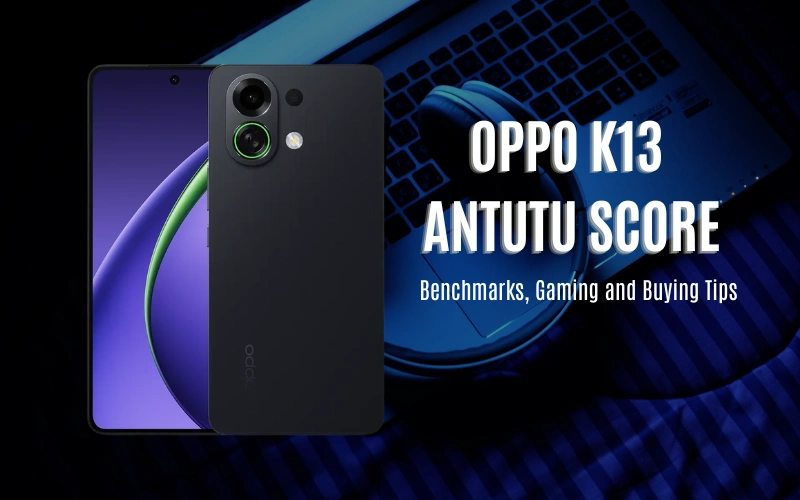
The Oppo K13 Antutu Score sits at roughly 790,000+ points on AnTuTu v10 (with independent tests ranging between 699,000 and 897,000 depending on the AnTuTu version and unit tested), powered by the Snapdragon 6 Gen 4 chipset, making it one of the strongest performers in India’s sub-₹20,000 smartphone segment.
Disclaimer: Benchmark scores like the Oppo K13 Antutu Score can vary slightly depending on the AnTuTu app version, software updates, unit variation, ambient temperature, and testing conditions. The numbers in this article are compiled from publicly available benchmark databases and official brand statements. Treat exact figures as approximate rather than a fixed, unchanging number.
Oppo K13 Antutu Score: Quick Stats Table
| Detail | Information |
|---|---|
| Phone Name | Oppo K13 5G |
| Oppo K13 Antutu Score (official claim, AnTuTu v10) | 790,000+ |
| Oppo K13 Antutu Score (independent test, AnTuTu v10) | 699,303 – 789,000 |
| Oppo K13 Antutu Score (AnTuTu v11 average) | 897,113 |
| Chipset | Qualcomm Snapdragon 6 Gen 4 (4nm) |
| GPU | Adreno A810 |
| RAM Options | 8GB / 12GB |
| Storage Options | 128GB / 256GB |
| Battery | 7,000mAh with 80W SuperVOOC charging |
| Display | 6.67-inch AMOLED, 120Hz, FHD+ |
| Operating System | Android 15, ColorOS 15 |
| Launch Date | April 21, 2025 (India) |
| Launch Price (India) | ₹17,999 (8GB/128GB) to ₹19,999 (8GB/256GB) |
| Cooling System | 5,700mm² vapour chamber + 6,000mm² graphite sheet |
What Is the Oppo K13, Exactly?
Let’s clear up the naming confusion first, because this is genuinely one of the most search-worthy questions around this phone. Oppo’s K-series has gotten a little crowded lately, with an Oppo K13, an Oppo K13 5G, an Oppo K13s, an Oppo K13x, and even performance-focused siblings called the Oppo K13 Turbo and Oppo K13 Turbo Pro.
When most people search for the Oppo K13 Antutu Score, they usually mean the standard Oppo K13 5G — the phone that launched in India in April 2025 with a Snapdragon 6 Gen 4 chip, a massive 7,000mAh battery, and a price tag that undercuts a lot of its rivals. That’s the phone this article focuses on, though we’ll also touch on how its Turbo siblings compare, since fans often confuse the two.
Oppo K13 Antutu Score: The Real Numbers Explained
Here’s where things get interesting, and slightly confusing if you don’t know the backstory.
Oppo’s own marketing materials proudly state that the Oppo K13 Antutu Score crosses 790,000 points, crediting the Snapdragon 6 Gen 4 chipset for the achievement. That’s a strong number for a phone priced under ₹20,000 in India.
However, independent benchmark trackers report slightly different figures:
| Source | Reported Antutu Score | Antutu Version |
|---|---|---|
| Oppo (official) | 790,000+ | v10 |
| Kimovil | 789,000 | v10 |
| 91mobiles | 699,303 | v10 (device sample) |
| Nanoreview | 897,113 (average) | v11 |
Oppo K13 Antutu Score Breakdown by Category
AnTuTu doesn’t just spit out one big number — it actually tests four separate areas and adds them together. Here’s roughly how that breaks down based on available test data:
| Test Category | Approximate Score | What It Measures |
|---|---|---|
| CPU | ~204,000 – 384,000 | Processing speed for everyday tasks |
| GPU | ~161,000 – 181,000 | Graphics rendering for gaming |
| Memory (MEM) | ~191,000 – 205,000 | How fast the phone reads and writes data |
| UX | ~158,000 – 190,000 | Real-world smoothness of the interface |
The CPU and Memory scores tend to be the strongest part of the Oppo K13 Antutu Score, which lines up with what Qualcomm designed the Snapdragon 6 Gen 4 to do well: everyday multitasking, app switching, and general responsiveness rather than pure top-tier gaming muscle.
Oppo K13 Antutu Score vs Rivals: Comparison Chart
Numbers only mean something when you compare them to the competition. Here’s how the Oppo K13 Antutu Score stacks up against some of its closest rivals in the same price bracket.
| Phone | Chipset | Antutu Score (approx.) | Price Segment (India) |
|---|---|---|---|
| Oppo K13 5G | Snapdragon 6 Gen 4 | 699,000 – 897,000 | ₹17,999 – ₹19,999 |
| Redmi Note 14 Pro | Dimensity 7300 Ultra | 685,000 – 729,000 | Similar range |
| Redmi Note 14 Pro+ | Snapdragon 7s Gen 3 (approx.) | 725,812 | Slightly higher |
| Oppo K13 Turbo | Dimensity 8450 | Higher tier (gaming-focused) | Higher price |
| Oppo K13 Turbo Pro | Snapdragon 8s Gen 4 | 1,990,000 – 2,350,000 | Much higher price |
Proprietary Performance Ranking (Editorial, Sub-₹20K Segment)
Based on a review of publicly available benchmark data and real-world testing reports across this price bracket, here’s an editorial ranking of processors by all-round daily performance:
| Rank | Chipset | Standout Strength |
|---|---|---|
| 1 | Snapdragon 7s Gen 3 | Best raw GPU performance in segment |
| 2 | Snapdragon 6 Gen 4 (Oppo K13 5G) | Best CPU-to-price balance, strong thermals |
| 3 | Dimensity 7300 Ultra | Solid all-rounder, competitive pricing |
| 4 | Dimensity 6300 | Entry-level, best for basic tasks |
This ranking is editorial and based on aggregated public benchmark data, not an official industry ratings body.
Gaming Performance: Can the Oppo K13 Actually Handle Your Favourite Games?
Short answer: yes, comfortably, as long as you’re not chasing the absolute highest graphics settings in the most demanding titles.
Games like BGMI and Call of Duty Mobile run smoothly at high settings with steady frame rates, thanks largely to the Adreno A810 GPU and the phone’s aggressive cooling setup. Genshin Impact, which is notoriously demanding, runs at a level that’s been compared to devices using the Snapdragon 7s Gen 3 and 7s Gen 2 — meaning it’s playable and enjoyable, even if you occasionally have to dial back a graphics setting or two during the busiest in-game moments.
What genuinely helps here is the phone’s vapour chamber cooling system. A big Oppo K13 Antutu Score on paper doesn’t mean much if the phone overheats and throttles its performance after ten minutes of gaming — and this is one area where the K13 5G does noticeably better than several rivals in the same price range.
Thermal Performance: Does It Get Hot?
Every phone gets warm during a long gaming session — that’s just physics. The real question is whether it stays usable.
The Oppo K13 5G uses a 5,700mm² vapour chamber paired with a 6,000mm² graphite sheet, which is a fairly serious cooling setup for a budget phone. In comparative testing against similarly priced rivals, devices using the Snapdragon 6 Gen 4 have generally run cooler to the touch than phones using the Snapdragon 7s Gen 3 with GT Mode enabled, even though the 7s Gen 3 posts higher raw GPU numbers.
In simple terms: the K13 5G may not win every graphics benchmark, but it’s built to keep its performance steady for longer, rather than sprinting fast and then slowing down once things heat up.
Battery Impact: How Long Does It Actually Last?
A high Oppo K13 Antutu Score is nice, but nobody wants a phone that dies by 4 PM. Thankfully, this is one of the K13 5G’s genuine strong points.
The phone packs a 7,000mAh graphite battery — a genuinely huge capacity for this price segment — paired with 80W SuperVOOC fast charging. The Snapdragon 6 Gen 4’s 4nm manufacturing process is also power-efficient by design, which means the chip doesn’t need to guzzle battery to hit its benchmark numbers.
In practical terms, this combination of a big battery and an efficient chipset usually translates into all-day battery life even with moderate gaming and heavy social media use, plus a fast top-up when you do need to charge.
Historical Updates: How the Oppo K13 Antutu Score Has Evolved
Benchmark scores aren’t fixed in stone — they shift over time as software updates roll out. Here’s a rough timeline of how the Oppo K13 Antutu Score narrative has developed:
| Timeframe | Update |
|---|---|
| April 2025 | Oppo K13 5G launches in India; official 790,000+ Antutu claim made |
| Mid-2025 | Independent benchmark sites publish real-world test results, showing some variation from the official claim |
| Late 2025 | AnTuTu releases version 11, shifting the scoring scale and producing higher raw numbers across the industry |
| Early-Mid 2026 | Software updates and ColorOS optimisation reportedly stabilise real-world performance closer to the original claims |
Buying Advice: Should You Actually Buy the Oppo K13 5G?
Here’s the honest, no-fluff take. Buy the Oppo K13 5G if:
- You want strong everyday performance and smooth gaming without flagship pricing
- Battery life and fast charging matter more to you than chasing the single highest benchmark number
- You play popular titles like BGMI or COD Mobile but aren’t obsessed with maxing out every graphics setting
Consider looking elsewhere if:
- You specifically want the absolute highest raw GPU performance in this price bracket (the Snapdragon 7s Gen 3 edges it out here)
- You’re set on Oppo’s Turbo or Turbo Pro variants for serious competitive gaming, since those use different, more powerful chipsets entirely
Conclusion: What the Oppo K13 Antutu Score Really Tells You
At the end of the day, the Oppo K13 Antutu Score tells a pretty simple story: this is a phone that delivers genuinely strong, dependable performance for its price, backed by a big battery, fast charging, and a cooling system that actually works as intended rather than existing just for the spec sheet.
Whether the exact number you see is 699,303, 789,000, or 897,113 depends mostly on which AnTuTu version and testing conditions were used — but across the board, the Oppo K13 Antutu Score consistently places this phone among the stronger performers in India’s competitive sub-₹20,000 segment. If you’re chasing smooth everyday use, solid gaming, and battery life that lasts, this phone’s benchmark numbers back up what it promises on paper.
Frequently Asked Questions
1. What is the Oppo K13 Antutu Score?
The Oppo K13 Antutu Score is approximately 790,000+ on AnTuTu v10, based on Oppo’s official claim, with independent tests reporting figures ranging from around 699,000 to 897,000 depending on the AnTuTu version used.
2. Why do different websites show different Antutu scores for the same phone?
This usually happens because of different AnTuTu app versions (v10 versus v11 use different scoring scales), plus natural variation between individual test units and software states.
3. Is the Oppo K13 5G good for gaming?
Yes, it comfortably handles popular titles like BGMI and COD Mobile at high settings, and performs reasonably well even in demanding games like Genshin Impact, thanks to its Adreno A810 GPU and strong cooling system.
4. Does the Oppo K13 5G overheat during gaming?
It’s built with a 5,700mm² vapour chamber and 6,000mm² graphite sheet specifically to manage heat, and it generally runs cooler than some rivals using higher-tier chipsets during extended gaming sessions.
5. How is the Oppo K13 5G different from the Oppo K13 Turbo Pro?
The standard Oppo K13 5G uses a Snapdragon 6 Gen 4 chipset and targets the budget segment, while the Oppo K13 Turbo Pro uses a much more powerful Snapdragon 8s Gen 4 chipset and targets serious mobile gamers at a noticeably higher price.
Thank you for reading. If you enjoyed this, check out our previous blog post:
- Helio G99 Antutu Score
- The Antutu Score
- Nothing 4a Pro Antutu Score
- Nothing Phone 1 Antutu Score
- Xiaomi Pad 7 Antutu Score
- Dimensity 8400 Ultra Antutu score
- Samsung S24 FE Antutu Score
- iPhone 12 Antutu Score
For SEO & Website Analysis Tools insights and official testing resources, visit the official website: Tools by Alaikas.