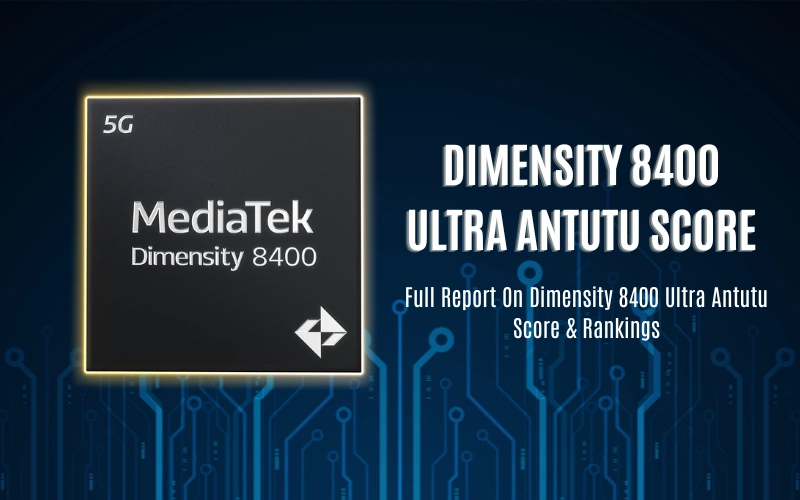
The Dimensity 8400 Ultra Antutu Score sits between roughly 1.57 million and 1.83 million points on AnTuTu v10, depending on the phone, software tuning, and test conditions — putting it comfortably in flagship-adjacent territory for a mid-range chip.
Disclaimer: Benchmark figures like the Dimensity 8400 Ultra Antutu score mentioned in this article are compiled from publicly available third-party test results (including device-specific runs) and are meant for general reference only. Actual scores can vary by phone model, software version, and test conditions. Readers are encouraged to check the official AnTuTu app or the specific phone brand’s published specifications for the most accurate, device-specific figures before making a purchase decision.
Dimensity 8400 Ultra — Quick Stats Table
| Spec | Detail |
|---|---|
| Chipset Name | MediaTek Dimensity 8400 Ultra |
| Launch | January 2025 |
| Manufacturing Process | 4nm (TSMC) |
| CPU Cores | 8-core, all Cortex-A725 (1×3.25GHz + 3×3GHz + 4×2.1GHz) |
| GPU | Arm Mali-G720 MC7 @ 1.3GHz |
| Dimensity 8400 Ultra Antutu Score (v10) | ~1,577,000 – 1,830,000 points (device-dependent) |
| Geekbench 6 Single-Core | ~1,580 – 1,640 points |
| Geekbench 6 Multi-Core | ~6,200 – 6,500 points |
| NPU | 8th-gen Gen-AI NPU 880 |
| Segment | Upper mid-range / “flagship-killer” |
| Common Phones | Poco X7 Pro, realme GT 7T |
What Exactly Is The Dimensity 8400 Ultra?
Let’s keep this simple. The Dimensity 8400 Ultra is MediaTek’s mid-to-upper-range chipset, built to give flagship-like speed without the flagship price tag. It’s not trying to dethrone Apple’s A-series or Qualcomm’s top Snapdragon Elite chips — it’s playing a smarter game. It wants to be the chip that makes a ₹25,000–₹30,000 phone feel like it costs twice as much.
The word “Ultra” here doesn’t mean a completely different silicon design. It usually points to a chip variant that’s been tuned for slightly better sustained performance and thermal handling inside the specific phone it powers. So when you see “Dimensity 8400” and “Dimensity 8400 Ultra” listed separately, know that the core architecture is largely the same — the difference lies mostly in tuning, clock behaviour, and how well the phone’s cooling system lets the chip stretch its legs.
Breaking Down The Dimensity 8400 Ultra Antutu Score
The Antutu benchmark score isn’t just one random number. AnTuTu doesn’t just spit out one random number. It adds up scores from four main test categories, and understanding this breakdown helps you actually read a benchmark instead of just staring at a big number and going “wow.”
| Test Category | What It Measures | Typical Share of Total |
|---|---|---|
| CPU | Raw processing speed, math, logic | ~35% |
| GPU | Graphics rendering, gaming smoothness | ~35% |
| Memory | RAM speed and data handling | ~15% |
| UX | Real app-switching, scrolling, video decode | ~15% |
On real test runs (Poco X7 Pro units), the Dimensity 8400 Ultra has posted CPU scores in the 580,000-point range and GPU scores crossing 550,000 points — which is a genuinely strong GPU number for a chip in this price bracket. That GPU muscle is why the chipset earned a reputation as a gaming-friendly option almost overnight.
Why Does The Dimensity 8400 Ultra Antutu Score Vary So Much?
This is the question we get asked the most, so let’s answer it honestly instead of pretending there’s one magic number.
- Software skin differences – A phone running a heavier custom Android skin can score lower than a lighter, cleaner build, even with identical hardware.
- RAM and storage variant – 8GB vs 12GB RAM models, or UFS 3.1 vs UFS 4.0 storage, change the memory sub-score noticeably.
- Thermal throttling – A phone with a small vapour chamber or thin body will heat up faster and clock down mid-test, quietly shaving points off the final number.
- AnTuTu version – v9 and v10 scores are not directly comparable, and this trips up a lot of casual comparisons online.
- Background apps and battery mode – Yes, this genuinely affects results. A phone in battery saver mode will always score lower.
Dimensity 8400 Ultra vs The Competition (Comparison Table)
Numbers mean very little in isolation. Here’s how the Dimensity 8400 Ultra Antutu score stacks up against its closest rivals, based on publicly available benchmark runs.
| Chipset | Antutu v10 Score (approx.) | Segment |
|---|---|---|
| Dimensity 8400 Ultra | ~1,577,000 – 1,830,000 | Upper mid-range |
| Snapdragon 8s Gen 3 | ~1,654,000 – 1,655,000 | Upper mid-range |
| Snapdragon 7+ Gen 3 | ~1,400,000 – 1,450,000 | Mid-range |
| Dimensity 9200 | ~1,430,000 – 1,530,000 | Older flagship |
| Snapdragon 8 Gen 3 | ~1,750,000 | Flagship |
Here’s the honest takeaway: on paper, the Dimensity 8400 Ultra trades blows with — and sometimes beats — chips that used to sit a full price tier above it just a year earlier. That’s the real story here, more than any single number. Depending on the exact device and test run, the Dimensity 8400 Ultra Antutu score can edge past the Snapdragon 8s Gen 3, particularly in GPU-heavy sub-tests.
Real-World Gaming Performance: Does The Score Actually Matter?
Here’s where we put on our “used it in real life” hat instead of just quoting spec sheets.
A big AnTuTu number is nice for bragging rights, but what actually matters is: can you play BGMI at high frame rates without your phone turning into a hand warmer? Based on real device testing (Poco X7 Pro), the answer leans positive. The Dimensity 8400 Ultra comfortably handles:
- BGMI/PUBG Mobile at Ultra HD graphics with smooth frame rates for extended sessions
- Call of Duty Mobile at high settings without major stutter
- Genshin Impact at medium-high settings, though sustained play does bring some warmth and mild throttling after 30+ minutes
The Mali-G720 MC7 GPU inside the Dimensity 8400 Ultra is genuinely one of the stronger GPUs you’ll find below the true flagship tier. In 3DMark Wild Life Extreme stress tests, it has shown better stability under sustained load than several same-price Snapdragon rivals — a small but meaningful win for anyone who games for longer stretches rather than quick five-minute rounds.
Pros & Cons Of The Dimensity 8400 Ultra
| Pros | Cons |
|---|---|
| Strong Dimensity 8400 Ultra Antutu score for its price class | Single-core performance trails top Snapdragon chips |
| Excellent GPU for mid-range gaming | Can warm up during long gaming sessions |
| Good multi-core performance for multitasking | Wi-Fi 6 only (no Wi-Fi 7 like some rivals) |
| Efficient 4nm process helps battery life | Camera ISP tuning varies a lot by phone brand |
| Found in genuinely affordable phones | Software optimisation inconsistency across brands |
Which Phones Use The Dimensity 8400 Ultra?
As of mid-2026, the chipset (and its close sibling, the standard Dimensity 8400) powers several well-known mid-range devices, including:
| Phone | Approx. Price Segment | Notable For |
|---|---|---|
| Poco X7 Pro | ₹25,000 – ₹28,000 | Gaming-focused, most-benchmarked device with this chip |
| realme GT 7T | ₹27,000 – ₹31,000 | Balanced camera + performance package |
This is a shortlist of the most talked-about devices; more phones using this chipset continue to launch through 2026 as brands chase the “flagship performance, mid-range price” pitch.
A Quick History: Where Does The Dimensity 8400 Ultra Fit In MediaTek’s Lineup?
MediaTek didn’t just wake up one day and build the Dimensity 8400 Ultra out of nowhere. It’s the latest step in a lineage that includes the Dimensity 8200, 8300, and 8300-Ultra — each generation nudging the CPU and GPU a little further while keeping power draw in check.
What makes the 8400 series stand out from its predecessors is the “All Big Core” CPU design. Older mid-range chips usually mixed a few powerful cores with several small, weak “efficiency” cores to save battery. The Dimensity 8400 Ultra instead uses eight Cortex-A725 cores, all of which are considered “big” cores, just running at different clock speeds. This is unusual for a chip in this price bracket, and it’s the main reason the Dimensity 8400 Ultra Antutu Score looks so competitive against pricier flagship silicon — there’s simply more raw horsepower under the hood than you’d expect at this price point.
How Is The Antutu Score Actually Calculated? (For The Curious Reader)
A lot of people quote benchmark numbers without ever knowing how they’re generated, so here’s the simple version.
AnTuTu runs a series of short, intense tests — things like 3D rendering scenes, mathematical stress loops, memory read/write cycles, and simulated everyday tasks like scrolling through a photo gallery or switching apps. Each of these tests produces a sub-score. Those sub-scores (CPU, GPU, Memory, UX) are then added together to create the final total — which is the number you see reported as the Dimensity 8400 Ultra Antutu Score.
This matters for one simple reason: a phone could technically have a slightly lower total score but still feel faster in daily use if its UX sub-score (the part that mimics real app behaviour) is stronger. So next time you compare two phones purely by their headline Antutu benchmark score, it’s worth peeking at the sub-scores too, if the review site provides them.
Battery Life And Efficiency: The Often-Ignored Side Of Performance
Raw power is fun to talk about, but nobody wants a phone that dies by 4 PM. The good news here is that the Dimensity 8400 Ultra is built on a 4nm process, which is the same manufacturing tier used in several genuine flagship chips. Smaller manufacturing processes generally mean better performance-per-watt, and that shows up in real use.
Phones running the Dimensity 8400 Ultra, like the Poco X7 Pro, have generally reported solid all-day battery performance even with heavier usage patterns like gaming and social media scrolling. The efficient core design plays nicely with large batteries (commonly 5,000mAh–6,000mAh in devices carrying this chip), meaning you’re not sacrificing screen-on time just because the chipset is fast.
The AI Angle: What The NPU Actually Does For You
Every chipset launch these days comes with an “AI” pitch, and it’s easy to roll your eyes at the marketing buzzwords. But the 8th-generation Gen-AI NPU inside the Dimensity 8400 Ultra does have genuinely useful real-world jobs:
- Camera processing — better night-mode photos, faster HDR merging, more natural skin tones
- On-device features — things like live translation, smart photo editing, and background noise cancellation on calls
- Battery-aware AI tasks — the NPU handles many of these jobs more efficiently than pushing the same workload through the CPU or GPU, which indirectly helps battery life
Dimensity 8400 Ultra Vs Snapdragon 8s Gen 3: Which Should You Actually Pick?
This comparison deserves its own section because it’s the single most-asked question in every comment section under a chipset review. Both chips sit in almost the same price and performance bracket, so the choice usually comes down to what you personally value most.
If gaming and multi-core performance are your priority, the Dimensity 8400 Ultra vs Snapdragon 8s Gen 3 debate tends to favour MediaTek’s chip — its GPU numbers and multi-core Geekbench scores are consistently a little stronger across multiple independent test runs. If snappy single-app responsiveness and slightly better connectivity (Wi-Fi 7 support on the Snapdragon side) matter more to you, the Qualcomm option pulls ahead.
Neither chip is a “wrong” choice at this price point — both are excellent value picks in 2026, and the real difference often comes down to which phone brand tunes its software better around the chip it’s using.
Decision Matrix: Should You Buy A Phone With The Dimensity 8400 Ultra?
| If You Are… | Verdict |
|---|---|
| A mobile gamer on a mid-range budget | Strong yes — GPU performance justifies the price |
| Someone who wants the fastest single-core speed for snappy UI | Consider Snapdragon 8s Gen 3 alternatives too |
| Focused on battery life and all-day use | Strong yes — 4nm efficiency helps here |
| Someone who prioritises camera AI features | Good, but check the phone brand’s own camera tuning, not just the chip |
| A heavy multitasker (many apps open at once) | Strong yes — multi-core performance is a genuine strength |
Conclusion
To sum it up simply: the Dimensity 8400 Ultra Antutu score — sitting anywhere from roughly 1.57 million to 1.83 million points depending on the device — represents genuinely strong mid-range performance that punches above its price tag. The chipset’s biggest strength is its GPU, making it a smart pick for gamers who don’t want to pay flagship prices. Its weak spot remains single-core speed compared to top Snapdragon chips, along with some thermal warming during longer sessions. If you’re comparing phones purely by chipset muscle, the Dimensity 8400 Ultra Antutu score tells you this chip has genuinely earned its “flagship-killer” reputation for 2026 — just remember to look beyond the number and check real-world reviews for the exact phone model you’re eyeing.
Frequently Asked Questions
1. What is a good Dimensity 8400 Ultra Antutu score?
Anywhere from 1.5 million to 1.8 million+ points on AnTuTu v10 is considered a strong, competitive score for this chipset’s price segment.
2. Is the Dimensity 8400 Ultra better than Snapdragon 8s Gen 3?
It’s close. The Dimensity 8400 Ultra often shows a stronger GPU score, while the Snapdragon 8s Gen 3 tends to edge ahead in single-core CPU speed.
3. Why does my phone’s Antutu score differ from the official Dimensity 8400 Ultra Antutu score?
Software version, RAM variant, background apps, and even battery mode can all shift your score up or down from published averages.
4. Does the Dimensity 8400 Ultra support Wi-Fi 7?
No, it currently supports Wi-Fi 6, while some rival chips in the same price bracket support the newer Wi-Fi 7 standard.
5. Is the Dimensity 8400 Ultra good for gaming?
Yes. Its Mali-G720 MC7 GPU handles popular titles like BGMI and Call of Duty Mobile smoothly at high settings, making it a solid gaming-value chip.
Thank you for reading. If you enjoyed this, check out our previous blog post:
- Helio G99 Antutu Score
- The Antutu Score
- Nothing 4a Pro Antutu Score
- Nothing Phone 1 Antutu Score
- Xiaomi Pad 7 Antutu Score
For SEO & Website Analysis Tools insights and official testing resources, visit the official website: Tools by Alaikas.