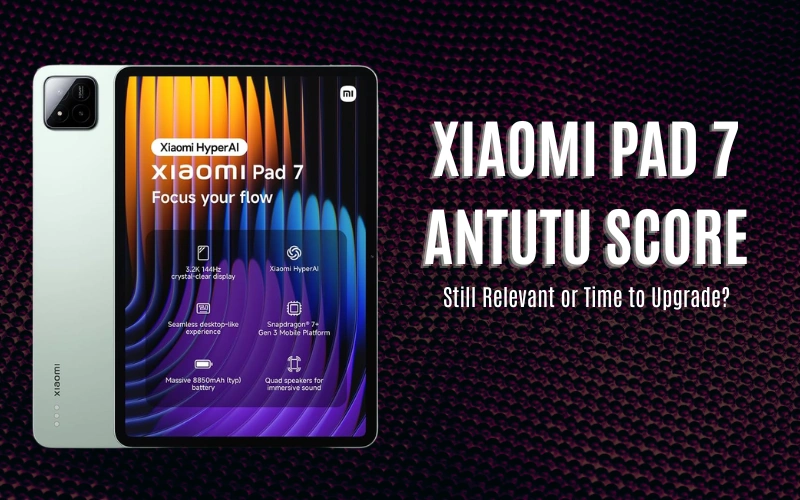
The Xiaomi Pad 7 Antutu Score sits between 1,387,993 and 1,697,444 points on AnTuTu v10/v11, powered by the Qualcomm Snapdragon 7+ Gen 3 chipset — a massive leap over its predecessor and one of the strongest scores in the mid-range tablet category.
Disclaimer: Benchmark scores may vary across individual units, regional variants, HyperOS software versions, ambient temperature, and whether Performance Mode is enabled. The scores presented in this article are averaged from multiple testing sources including AnTuTu database averages, Notebookcheck lab results, Kimovil, NanoReview, and community submissions. They are not guaranteed maximum scores. Always test your own device for accurate personal results.
Quick Stats: Xiaomi Pad 7 At a Glance
| Feature | Details |
|---|---|
| Device Name | Xiaomi Pad 7 |
| Launch Date | October 2024 (China), January 2025 (India), March 2025 (Global/MWC) |
| Chipset | Qualcomm Snapdragon 7+ Gen 3 (4nm) |
| AnTuTu Score (v10) | ~1,387,993 – 1,389,000 |
| AnTuTu Score (v11 avg.) | ~1,649,732 – 1,697,444 |
| CPU Score (v11) | 552,288 |
| GPU Score (v11) | 419,835 |
| Memory Score (v11) | 290,516 |
| UX Score (v11) | 434,805 |
| RAM Options | 8GB / 12GB LPDDR5X |
| Storage | 128GB / 256GB (UFS 3.1 / UFS 4.0) |
| Display | 11.2-inch IPS, 3200×2136, 144Hz |
| Battery | 8850 mAh, 45W charging |
| Starting Price | ~$281 (Global), ₹24,999 (India) |
| OS | HyperOS 2.0 based on Android 15 |
| Percentile Rank | Better than 86% of devices tested |
So, What Even Is an Antutu Score?
Before we get into the juicy Xiaomi Pad 7 Antutu Score numbers, let’s make sure everyone’s on the same page — no jargon, promise.
AnTuTu is basically the report card of your tablet. It runs a series of tests on your device — how fast the processor works (CPU), how well the graphics chip handles visuals (GPU), how quickly it reads and writes data (Memory), and how smooth everyday tasks feel (UX or User Experience). Add them all up, and you get one final number.
The higher the number, the faster the device. Simple as that.
Now here’s the fun part — the Xiaomi Pad 7 Antutu Score doesn’t just pass with decent marks. It scores somewhere between 1.38 million and 1.69 million depending on the version of AnTuTu used. That’s not a number you sneeze at for a tablet priced under $415.
Xiaomi Pad 7 Antutu Score: The Full Breakdown
Let’s crack open the benchmark and see what’s really going on under the hood.
AnTuTu v10 Score
The Xiaomi Pad 7 Antutu Score on AnTuTu version 10 lands at approximately 1,387,993 to 1,389,000 points. This was one of the first scores reported when the device launched in late 2024 and early 2025.
AnTuTu v11 Score
When tested on the newer AnTuTu v11, the average Xiaomi Pad 7 Antutu Score climbs higher, sitting at around 1,649,732 to 1,697,444 points. The newer version tests slightly differently and tends to give scores a bump — but the performance is real.
Score Breakdown (AnTuTu v11)
| Sub-Test | Score |
|---|---|
| CPU | 552,288 |
| GPU | 419,835 |
| Memory | 290,516 |
| UX (User Experience) | 434,805 |
| Total | ~1,697,444 |
The CPU and UX scores are the stars of the show here. The Snapdragon 7+ Gen 3’s Cortex-A715 and Cortex-A510 cores are doing excellent work, and the UX score tells you that everyday scrolling, app-switching, and animations feel genuinely smooth.
What Chipset Powers These Numbers?
The brain behind the impressive Xiaomi Pad 7 Antutu Score is the Qualcomm Snapdragon 7+ Gen 3, built on TSMC’s 4nm process node.
Here’s a quick chip profile:
| Chipset Detail | Snapdragon 7+ Gen 3 |
|---|---|
| Process Node | 4nm (TSMC) |
| CPU Architecture | 1x Cortex-X4 (2.8GHz) + 3x Cortex-A720 (2.6GHz) + 4x Cortex-A520 (1.9GHz) |
| GPU | Adreno 732 |
| AI Engine | Qualcomm Hexagon NPU |
| RAM Type Supported | LPDDR5X |
| Storage Type Supported | UFS 3.1 / UFS 4.0 |
| AnTuTu Category | Upper Mid-Range |
How Does the Xiaomi Pad 7 Antutu Score Compare to the Competition?
Now this is where things get really interesting. Numbers alone don’t tell you much. Context is everything.
Comparison Table: Tablets in the Same Price Range
| Tablet | Chipset | AnTuTu Score (Approx.) | Starting Price |
|---|---|---|---|
| Xiaomi Pad 7 | Snapdragon 7+ Gen 3 | ~1,650,000 (v11) | ~$281 |
| Xiaomi Pad 7 Pro | Snapdragon 8s Gen 3 | ~1,779,758 (v11) | ~$349 |
| Xiaomi Pad 7 Ultra | Snapdragon 8 Gen 3 | ~2,697,004 (v10) | Premium |
| Xiaomi Pad 6 | Snapdragon 870 | ~800,000 | ~$250 |
| Samsung Galaxy Tab A9+ | Snapdragon 695 | ~350,000–400,000 | ~$154–$215 |
| Apple iPad 10th Gen | Apple A14 Bionic | ~900,000–1,000,000 | ~$350–$449 |
| Apple iPad 11th Gen (2025) | Apple A16 Bionic | ~1,200,000–1,300,000 | ~$349+ |
The Xiaomi Pad 7 Antutu Score absolutely crushes the Samsung Galaxy Tab A9+ in raw benchmark numbers. It also comfortably beats the Apple iPad 10th Gen and even gives the newer iPad 11th Gen (2025) a real fight — all at a significantly lower price point in India and several global markets.
Gaming Performance: Can It Actually Handle Real Games?
Here’s the thing — a benchmark number is one thing, but what happens when you actually fire up a game and play for two hours straight?
The Xiaomi Pad 7 Antutu Score tells a promising story, and real-world gaming mostly backs that up.
Games Tested and Results
| Game | Settings Tested | Performance |
|---|---|---|
| BGMI / PUBG Mobile | High / Smooth + Extreme | Stable 60 FPS |
| Genshin Impact | Medium settings | 40–60 FPS, some drops |
| Call of Duty: Mobile | Very High Graphics | Smooth 60 FPS |
| Asphalt Legends Unite | High | Steady 60 FPS |
| Real Racing 3 | Max Settings | No noticeable lag |
| Free Fire MAX | High | Very smooth |
For casual to mid-core gamers, the Xiaomi Pad 7 handles everything beautifully. You’ll hit 60 FPS on most popular titles without breaking a sweat.
Thermal Performance: Does It Get Too Hot?
This is a question that often doesn’t get enough attention — and it matters a lot for long gaming or streaming sessions.
The good news: the Xiaomi Pad 7 Antutu Score stays consistent across multiple benchmark runs, which already hints at solid thermal management.
Thermal Data (Real-World Testing)
| Scenario | Surface Temperature |
|---|---|
| Idle | ~28.8°C |
| Average Under Load | ~33.5°C |
| Maximum Recorded (Upper Surface) | ~41.7°C |
| Maximum Recorded (Lower Surface) | ~39.4°C |
The Snapdragon 7+ Gen 3 only throttles between 1.5% and 13% under sustained load, which is impressively low. In practical terms? You might barely notice any performance drop during long play sessions.
Compare that to some older chips that throttle 30–40% under heat pressure, and the Pad 7 looks like a champ.
Battery Impact of Benchmarks and Gaming
The 8850mAh battery is one of the Xiaomi Pad 7’s biggest selling points, and it plays directly into how the Xiaomi Pad 7 Antutu Score translates to real-world usability.
Battery Performance Estimates
| Usage Type | Estimated Duration |
|---|---|
| Video Playback | Up to 20.4 hours |
| Music Playback | Up to 258.1 hours |
| Casual Browsing | 10–12 hours |
| Gaming (Heavy) | 5–7 hours |
| Benchmark Testing | Battery drops ~15% per full run |
The 4nm process efficiency of the Snapdragon 7+ Gen 3 means the chip sips power rather than gulping it. That’s a huge reason why the battery performance is so strong despite a large, bright display running at high refresh rates.
Historical Benchmark Updates: From Pad 5 to Pad 7
Seeing how Xiaomi’s tablet line has evolved makes the Xiaomi Pad 7 Antutu Score even more impressive.
Xiaomi Pad Benchmark History
| Model | Year | Chipset | AnTuTu Score (Approx.) |
|---|---|---|---|
| Xiaomi Pad 5 | 2021 | Snapdragon 860 | ~550,000 |
| Xiaomi Pad 6 | 2023 | Snapdragon 870 | ~800,000 |
| Xiaomi Pad 7 | 2024/2025 | Snapdragon 7+ Gen 3 | ~1,650,000 (v11) |
| Xiaomi Pad 7 Pro | 2024/2025 | Snapdragon 8s Gen 3 | ~1,779,758 (v11) |
| Xiaomi Pad 7 Ultra | 2024 | Snapdragon 8 Gen 3 | ~2,697,004 (v10) |
Related Processors: How the Snapdragon 7+ Gen 3 Stacks Up
If you’ve ever wondered how the chip inside your Pad 7 compares to what else is out there, here’s a clean reference:
Processor Comparison Chart
| Processor | Device Tier | AnTuTu Score Range |
|---|---|---|
| Snapdragon 7+ Gen 3 (Pad 7) | Upper Mid-Range | 1,380,000–1,700,000 |
| Snapdragon 8s Gen 3 (Pad 7 Pro) | High-End Mid | 1,700,000–1,800,000 |
| Snapdragon 8 Gen 3 (Pad 7 Ultra) | Flagship | 2,500,000–2,700,000 |
| Snapdragon 870 (Pad 6) | Older Flagship | 750,000–850,000 |
| Dimensity 9400+ (Redmi Gaming Tab – upcoming) | Flagship | 2,800,000+ (projected) |
| Apple A16 Bionic (iPad 11 2025) | Apple Flagship | 1,200,000–1,300,000 |
Alternatives Worth Considering
If the Xiaomi Pad 7 Antutu Score has caught your attention but you’re still window shopping, here are the closest alternatives:
Alternatives Comparison
| Tablet | AnTuTu Score | Key Advantage | Price Range |
|---|---|---|---|
| Xiaomi Pad 7 Pro | ~1,779,758 | Snapdragon 8s Gen 3, slightly faster | ~$349 |
| POCO Pad X1 | ~1,400,000 | Lower price, similar performance tier | ~$267 |
| Redmi Pad 2 Pro 5G | ~1,100,000–1,200,000 | 5G option, affordable | ~$250 |
| Samsung Galaxy Tab S10 FE | ~1,200,000–1,300,000 | Samsung ecosystem, AMOLED | ~$400 |
| Lenovo Tab Plus | ~700,000–800,000 | Great speakers, budget pick | ~$200 |
| Apple iPad 11th Gen (2025) | ~1,200,000–1,300,000 | iPadOS ecosystem, premium build | $349+ |
Buying Advice: Should You Pick the Xiaomi Pad 7?
Alright, let’s get practical. You’ve seen the Xiaomi Pad 7 Antutu Score, the benchmarks, the comparisons — but should you actually buy it?
Buy it if:
- You want strong benchmark performance without flagship prices
- You’re a casual to mid-core gamer who plays titles like BGMI, COD Mobile, or Asphalt
- You need a productivity workhorse for split-screen multitasking, note-taking, and video streaming
- Battery life matters a lot (8850mAh is serious)
- You want a big, bright 144Hz display under $400
Skip it if:
- You need the absolute top benchmark scores — look at the Pad 7 Ultra or flagship Android tablets
- You want an OLED display (the Pad 7 uses IPS LCD)
- You’re deep in the Apple ecosystem and prefer iPadOS
- You need a fingerprint sensor (the Pad 7 doesn’t have one)
- You want 16GB RAM — even the Pro tops out at 12GB
RAM/Storage Pick Guide
| Your Use Case | Recommended Variant |
|---|---|
| Light use, studying, streaming | 8GB RAM / 128GB |
| Multitasking, content creation | 8GB or 12GB / 256GB |
| Heavy gaming + productivity | 12GB RAM / 256GB (fastest UFS 4.0) |
Conclusion: The Xiaomi Pad 7 Antutu Score Earns Its Bragging Rights
So there you have it — the full picture of the Xiaomi Pad 7 Antutu Score, broken down so clearly you could explain it to your grandmother (and she’d be impressed too).
Here are the key takeaways:
- The Xiaomi Pad 7 Antutu Score ranges from ~1.38 million (v10) to ~1.69 million (v11), making it one of the strongest mid-range tablet performers of 2025–2026.
- The Snapdragon 7+ Gen 3 delivers outstanding value — nearly double the performance of the older Pad 6 at a similar price.
- Thermal performance is excellent with minimal throttling under load.
- Gaming is smooth for casual and mid-core titles; demanding games may require settings adjustments.
Frequently Asked Questions
1. What is the exact Xiaomi Pad 7 Antutu Score?
The Xiaomi Pad 7 Antutu Score is approximately 1,387,993 to 1,389,000 on AnTuTu v10 and 1,649,732 to 1,697,444 on AnTuTu v11 (average community score). The v11 score is higher because of updates to the benchmark’s scoring methodology.
2. Is the Xiaomi Pad 7 good for gaming based on its Antutu Score?
Yes, absolutely. The Xiaomi Pad 7 Antutu Score of ~1.65 million on v11 translates to smooth gameplay for most Android titles including BGMI, COD Mobile, and Asphalt. For ultra-demanding games like Genshin Impact on max settings, you may need to reduce graphics slightly.
3. How does the Xiaomi Pad 7 Antutu Score compare to the Xiaomi Pad 6?
The difference is massive. The Xiaomi Pad 7 Antutu Score (~1,650,000 on v11) is nearly double the Xiaomi Pad 6’s score (~800,000), thanks to the upgrade from the older Snapdragon 870 to the newer Snapdragon 7+ Gen 3.
4. Does the Xiaomi Pad 7 throttle under sustained load?
Barely. Lab testing shows the Snapdragon 7+ Gen 3 in the Xiaomi Pad 7 only throttles between 1.5% and 13% under heavy load — which means you’ll barely feel any performance drop during long gaming or benchmark sessions.
5. Which is better: Xiaomi Pad 7 or Xiaomi Pad 7 Pro in terms of Antutu score?
The Xiaomi Pad 7 Pro scores around 1,779,758 on AnTuTu v11 (powered by Snapdragon 8s Gen 3), making it about 7–8% faster than the standard Pad 7. The difference is noticeable in very demanding tasks but minimal in everyday use.
Thank you for reading. If you enjoyed this, check out our previous blog post:
For SEO & Website Analysis Tools insights and official testing resources, visit the official website: Tools by Alaikas.