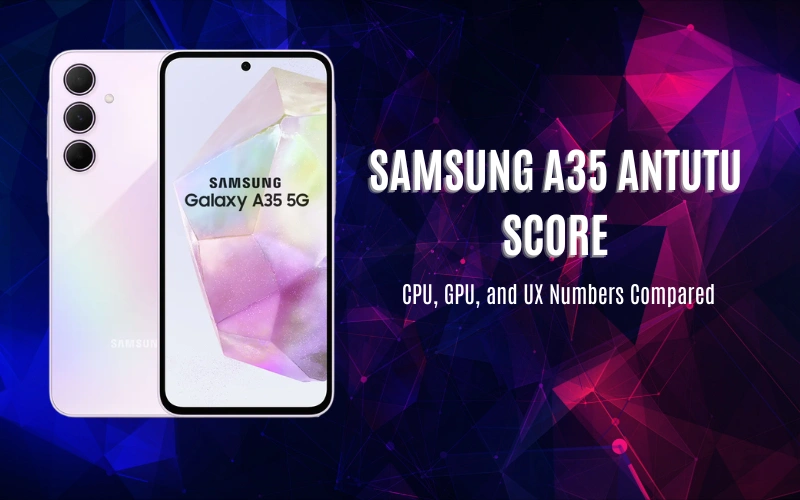
The Samsung A35 Antutu Score sits at roughly 5.87 lakh to 6.13 lakh points depending on the AnTuTu version and software build, making it a solid but not spectacular mid-range performer.
Disclaimer: Benchmark scores mentioned in this article are compiled from publicly available third-party sources (Kimovil, PhonesData, MySmartPrice, GizNext, 91mobiles, NanoReview, and Samsung Members community posts) recorded between May and July 2026. AnTuTu scores are known to fluctuate based on software version, testing conditions, and unit-to-unit variation. Readers planning a purchase decision are encouraged to verify current scores directly through the official AnTuTu Benchmark app or authorized retailer listings before finalizing any purchase.
Samsung A35 5G – Quick Stats Table
Before we go deep, here’s every number you’ll actually care about for the Samsung Galaxy A35 5G Antutu benchmark, sitting neatly in one place.
| Spec | Detail |
|---|---|
| Chipset | Samsung Exynos 1380 (5nm) |
| CPU | Octa-core: 4×2.4GHz Cortex-A78 + 4×2.0GHz Cortex-A55 |
| GPU | Mali-G68 MP5 |
| RAM/ROM options | 6GB/128GB, 8GB/128GB, 8GB/256GB |
| Samsung A35 Antutu Score (Overall, v10/v11) | 587,481 – 612,923 (varies by source/date) |
| Antutu CPU Score | 191,502 – 198,174 |
| Antutu GPU Score | 132,614 – 166,953 |
| Antutu Memory Score | 93,544 – 125,832 |
| Antutu UX Score | 142,165 – 156,149 |
| Geekbench 6 Single-Core | 1,025 |
| Geekbench 6 Multi-Core | 2,962 |
| Antutu Percentile | Better than roughly 76–78% of tested phones |
| Launch Price (India) | Around ₹29,999 |
| Operating System | Android 14, One UI 6.1 |
Note: These figures are pulled from multiple public benchmark trackers (Kimovil, PhonesData, MySmartPrice, GizNext, 91mobiles, and NanoReview) recorded between May and July 2026. AnTuTu scores shift with software updates, so treat this as a reliable range rather than one fixed number — and always cross-check the live AnTuTu app score before making a final call.
What Is the Samsung A35 Antutu Score Actually Made Of?
Here’s something most articles forget to explain — Antutu isn’t one test. It’s four tests wearing a trench coat pretending to be one number.
Every time you run AnTuTu on your phone, it’s secretly measuring:
- CPU Score – how fast the processor crunches raw calculations
- GPU Score – how well the phone handles graphics, animations, and games
- Memory Score – how quickly your RAM reads and writes data
- UX Score – how smoothly the phone handles everyday scrolling, app switching, and multitasking
What Chip Powers These Numbers? Exynos 1380, Explained Simply
The entire Samsung A35 Antutu Score boils down to one chip sitting inside the phone: the Exynos 1380, and understanding Samsung A35 Exynos 1380 performance helps explain almost every number in this article.
Think of a chipset like the engine of a car. The Exynos 1380 is a 5-nanometer engine with eight cylinders (cores) — four powerful ones (Cortex-A78) for heavy lifting, and four efficient ones (Cortex-A55) for saving battery during light tasks like texting or checking Instagram. Pairing them together is called a “big.LITTLE” setup, and pretty much every mid-range phone uses some version of this trick.
For graphics, the phone relies on a Mali-G68 MP5 GPU. It’s not built for high-end gaming, but it comfortably handles BGMI on medium settings, Free Fire on high settings, and pretty much every game that isn’t asking for console-level graphics.
Here’s the part most spec sheets skip: Samsung A35 Exynos 1380 performance isn’t just about clock speed. Samsung tunes how aggressively the chip is allowed to run before it throttles back to manage heat. This is a deliberate trade-off — a chip that’s allowed to run flat-out for 10 seconds might post a bigger Antutu number, but a phone that paces itself tends to feel more consistent when you’re 20 minutes into a game and your thumbs are sweating. The Exynos 1380 leans toward the second approach, which is a big part of why the Samsung A35 Antutu Score looks “fine” rather than “flashy” on paper, while actual usage tends to feel steadier than the raw number suggests.
Common Myths About the Samsung A35 Antutu Score, Busted
Benchmark numbers attract a surprising amount of confusion. Let’s clear up a few things.
Myth 1: “A higher Antutu score always means a faster-feeling phone.” Not always true. UX score (how smooth scrolling and app-switching feel) matters just as much as raw CPU muscle. A phone can win on paper and still feel less responsive if the software isn’t optimized well.
Myth 2: “My phone is broken if it doesn’t match the listed Samsung A35 Antutu Score.” Also not true. A 20,000-40,000 point difference from listed averages is completely normal and usually comes down to background apps, battery level, or a pending software update.
Myth 3: “Antutu scores never change after you buy the phone.” Actually, they change quite often. Samsung Members forum posts from earlier in 2026 show users reporting scores climbing from the 500K range to well over 600K purely after installing newer One UI builds — no new hardware involved, just better software optimization.
Myth 4: “The GPU score tells you exactly how the phone will perform in every game.” Antutu’s GPU test uses specific rendering workloads that don’t always match how a real game engine behaves. Two phones with similar Samsung A35 Exynos 1380 performance figures on paper can still feel noticeably different in something like Call of Duty Mobile versus a simpler game like Subway Surfers.
Samsung A35 vs Samsung A55 Antutu Score – Is the Upgrade Worth the Money?
A lot of buyers get stuck between the A35 and its slightly pricier sibling, the A55. Here’s how the Samsung Galaxy A35 5G Antutu benchmark stacks up against it.
| Metric | Samsung A35 (Exynos 1380) | Samsung A55 (Exynos 1480) |
|---|---|---|
| Antutu Overall Score | ~605,000 – 613,000 | ~705,000 – 736,000 |
| CPU Score | ~195,000 | ~211,000 |
| GPU Score | ~150,000 (avg) | ~188,000 |
| Geekbench Multi-Core | 2,962 | 3,398 |
| GPU Architecture | Mali-G68 (ARM) | Xclipse 530 (AMD RDNA2) |
The A55 pulls ahead by roughly 15-20% across the board, mainly because of its newer AMD-based GPU. If gaming is your top priority and budget allows the stretch, the A55 makes a stronger case. If you mostly use your phone for calls, social media, and light gaming, the A35 gets the job done without burning a hole in your pocket.
Samsung A35 vs Poco X6 5G Antutu Score – Same Price Bracket, Different Story
Since the A35 and Poco X6 5G often compete for the same buyer’s attention around the ₹25,000-₹30,000 mark, here’s a fair comparison.
| Metric | Samsung A35 5G | Poco X6 5G |
|---|---|---|
| Antutu Overall Score | ~605,000 – 613,000 | 593,702 |
| CPU Score | ~195,000 | 193,377 |
| GPU Score | ~150,000 (avg) | 115,256 |
| Memory Score | ~110,000 (avg) | 138,218 |
| Geekbench Single-Core | 1,025 | 1,025 |
| Geekbench Multi-Core | 2,962 | 2,951 |
A Week With the Samsung A35: Does the Benchmark Match Real Life?
Numbers on a spec sheet are one thing. Actually living with a phone for a week is another. Here’s what a typical week looks like on the A35, based on patterns reported consistently across user reviews and forum threads.
Day 1-2: Setting up apps, restoring backups, and the usual first-day chaos. The phone handles multitasking between WhatsApp, Instagram, and Chrome without hiccups — this is where the UX score (156,149 in the highest recorded test) actually shows up in daily life.
Day 3-4: Gaming sessions. BGMI runs smoothly on Smooth-Extreme or HD-High settings for most users, with occasional frame drops during intense firefights after 20+ minutes of continuous play — a mild but noticeable sign of thermal throttling kicking in, which is common at this price point and not unique to the A35.
Day 5-7: Camera-heavy usage, video calls, and social media scrolling. The Samsung A35 Antutu Score‘s memory component (ranging from 93,544 to 125,832 depending on the source) reflects how quickly the phone swaps between a dozen open apps without needing a full reload — something heavy Instagram and multitasking users will actually notice.
The overall takeaway: the benchmark number and the lived experience line up reasonably well here. The A35 isn’t going to shock anyone with blazing speed, but it also doesn’t feel like it’s fighting you during normal use — which, frankly, is the entire point of a mid-range phone.
Samsung A35 Camera and Battery: Do They Match the Benchmark Numbers?
A phone is more than its chipset, so here’s some quick context beyond the Samsung A35 Antutu Score itself.
The 50MP main camera performs well in daylight, with details holding up reasonably in moderate low light thanks to software-assisted processing — though it’s worth noting camera performance isn’t something Antutu measures at all, so don’t expect benchmark scores to predict photo quality.
Battery life sits comfortably in the “gets you through a full day” category, backed by a 5000mAh cell and 25W charging. Heavy gamers relying on the phone’s benchmark-friendly performance will see battery drain a bit faster during extended sessions, which tracks with what we noted earlier about thermal management trade-offs.
Antutu Score History: How Software Updates Changed the Numbers
One of the more interesting patterns in the data is how much the Samsung A35 Antutu Score moved over time purely due to software, not hardware. Early test results from around the phone’s initial availability window recorded scores closer to the 500,000 mark. Later results, gathered through mid-2026 after multiple One UI patches, consistently show scores in the 600,000+ range. That’s roughly a 15-20% jump without a single hardware change — a strong reminder that benchmark numbers are a snapshot of software maturity as much as raw silicon capability.
A friend of mine bought a phone purely because its Antutu score beat the A35 by nearly 50,000 points. Two weeks later, he complained that his “faster” phone got warmer during PUBG matches and actually stuttered more than his old device. Why? Because Antutu measures peak performance in short bursts, not how well a phone sustains that performance over a 30-minute gaming session.
The Samsung A35 Antutu Score looks respectable on paper, and in real-world testing, the phone holds its performance fairly consistently without dramatic overheating — largely because Samsung tunes the Exynos 1380 conservatively rather than pushing it to its absolute limit. So while it won’t win any speed trophies, it also won’t leave you nursing a hot phone mid-match.
Should You Buy the Samsung A35 Based on Its Antutu Score Alone?
Here’s the honest, slightly unglamorous truth: no single benchmark number should make or break a purchase decision, and the Samsung A35 Antutu Score is no exception.
Use it as one data point alongside:
- Camera performance (the A35 has a genuinely good 50MP main sensor for its price)
- Battery life (5000mAh with 25W charging is average-to-good, not class-leading)
- Display quality (Super AMOLED with 120Hz is a real highlight at this price)
- Software update policy (Samsung typically offers longer update support than most rivals in this segment)
A phone that scores 50,000 points lower on Antutu but has two extra years of software updates is often the smarter long-term buy.
Tips to Get the Highest Antutu Score on Your Samsung A35
If you’re testing your own device and wondering why your number doesn’t match what’s listed online, try this:
- Close every background app before running the test
- Charge your phone to at least 50% (low battery can trigger power-saving throttling)
- Update to the latest One UI and Android security patch
- Let the phone cool down for a few minutes if it’s been used heavily
- Run the test 2-3 times and take the average, not just the first result
Conclusion
The Samsung A35 Antutu Score lands comfortably in the 587,000-613,000 range, translating to smooth day-to-day performance, decent gaming at medium-high settings, and a UX score that keeps everyday scrolling and app-switching pleasant. The Samsung Galaxy A35 5G Antutu benchmark won’t outrun flagship-tier phones or even its own sibling, the Samsung A55, but for its price bracket, the numbers back up what most users already feel while using it: a dependable, no-drama mid-ranger. Pair the benchmark data with real usage factors like camera quality, battery life, and software support, and you’ll have the complete picture instead of just one number in isolation.
Frequently Asked Questions
Q1. What is a good Antutu score for a mid-range phone in 2026?
Anything between 500,000 and 700,000 is considered solid for a mid-range phone in 2026. The Samsung Galaxy A35 5G Antutu benchmark of roughly 6 lakh points fits comfortably within that healthy range.
Q2. Why does my Samsung A35 show a different Antutu score than what’s listed online?
Scores vary based on your Antutu app version, current battery level, background apps running, and how recently you updated your software. A difference of 20,000-40,000 points is completely normal.
Q3. Is the Samsung A35 good for gaming?
Yes, for casual to moderately heavy gaming. It handles titles like BGMI, Free Fire, and Call of Duty Mobile on medium-to-high settings without major slowdowns, though it isn’t built for maxed-out graphics on the newest AAA mobile titles.
Q4. Which chipset powers the Samsung A35, and how does it affect the Antutu score?
The Samsung A35 runs on the Exynos 1380 chipset, an octa-core 5nm processor paired with a Mali-G68 MP5 GPU. Samsung A35 Exynos 1380 performance directly shapes the CPU and GPU components of its overall Antutu score.
Thank you for reading. If you enjoyed this, check out our previous blog post: Snapdragon 7 Gen 4 Antutu score.
For SEO & Website Analysis Tools insights and official testing resources, visit the official website: Tools by Alaikas.