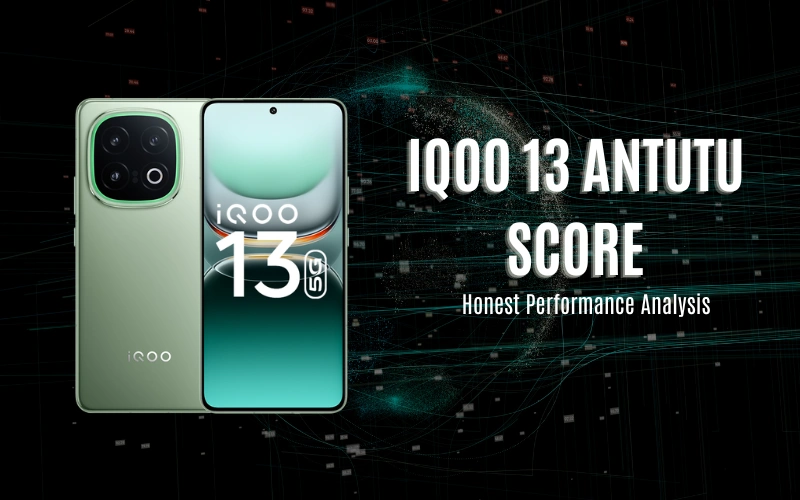
The iQOO 13 Antutu score ranges between roughly 2.6 million and 3.1 million points across different labs and firmware versions, placing it among the fastest Android phones tested in 2026.
Disclaimer: This article is compiled from publicly available benchmark sources, including AnTuTu-affiliated testing platforms and third-party review sites, as of July 2026. Antutu scores are known to vary across testing labs, firmware versions, and individual units, and figures presented here should be treated as approximate ranges rather than fixed, official numbers. Readers seeking exact current figures are encouraged to check official AnTuTu rankings or run their own device-specific test.
IQOO 13 Quick Stats Table
| Detail | Information |
|---|---|
| iQOO 13 Antutu Score | Roughly 2,678,000 to 3,116,670 points (varies by source and firmware) |
| Chipset | Qualcomm Snapdragon 8 Elite |
| CPU Sub-score | Around 580,000 to 902,000 points |
| GPU Sub-score | Around 1,158,000 to 1,220,000 points |
| Memory Sub-score | Around 389,000 to 507,000 points |
| UX Sub-score | Around 428,000 to 666,000 points |
| Geekbench Single-Core | Around 3,093 to 3,110 points |
| Geekbench Multi-Core | Around 9,770 to 9,854 points |
| Display | 2K LTPO AMOLED, up to 144Hz refresh rate |
| Battery | 6000mAh with 120W fast charging |
| iQOO 3 Antutu Benchmark Score (for comparison) | Around 588,000 to 723,200 points |
Why Does the iQOO 13 Antutu Score Vary So Much?
Here’s the thing nobody tells you upfront: there is no single official iQOO 13 Antutu score. Different websites, testers, and even different phone units of the exact same model can show different numbers. That’s not necessarily a red flag, it’s just how benchmarking actually works.
A few honest reasons for this:
- Firmware updates change performance. Early software builds often play it safe with battery life, while later updates unlock more GPU power, which pushes the score higher.
- Thermal conditions matter. AnTuTu tests run for several minutes straight, and if the phone heats up, it can throttle down and score lower. A cooler room and a fresh unit often score better.
- Regional variants differ. Indian units and Chinese units of the same phone sometimes ship with slightly different RAM speeds or power management settings, which can shift results.
- AnTuTu version matters. AnTuTu v10 and older AnTuTu 11 tests produce different numbers entirely, so comparing scores from different versions is like comparing apples to mangoes.
So when you see one site reporting the iQOO 13 Antutu score at 2.8 million and another reporting over 3.1 million, both could be accurate for their specific test conditions. This is a genuinely common pattern across flagship Android phones, not something unique to iQOO.
Breaking Down the iQOO 13 Antutu Score by Category
AnTuTu doesn’t just spit out one number, it actually tests four different areas of the phone and adds them together. Here’s a simple table showing what each part means:
| Test Category | What It Measures | Typical iQOO 13 Range |
|---|---|---|
| CPU | Raw processing power for apps, multitasking | 580,000 – 902,000 |
| GPU | Graphics performance for gaming, video | 1,158,000 – 1,220,000 |
| Memory (RAM) | How fast the phone reads and writes data | 389,000 – 507,000 |
| UX (User Experience) | Real-world smoothness, app switching, scrolling | 428,000 – 666,000 |
iQOO 13 Antutu Score vs iQOO 3 Antutu Benchmark Score: How Far Has It Come?
This comparison is honestly a fun one, because it shows just how far mobile chips have advanced in a few short years.
| Phone | Antutu Score (approx.) | Chipset | Release Year |
|---|---|---|---|
| iQOO 3 | 588,883 – 723,200 | Snapdragon 865 | 2020 |
| iQOO 13 | 2,678,000 – 3,116,670 | Snapdragon 8 Elite | 2024-25 |
Look at that gap. The iQOO 3 Antutu benchmark score topped out at around 723,200 points on the newer AnTuTu v10 scale, while the iQOO 13 Antutu score is regularly clearing 2.6 million and touching over 3.1 million in some tests. That’s roughly four times the raw performance in under five years, which honestly says a lot about how fast chip technology has moved, and also about AnTuTu’s own scoring scale changing over time to account for more powerful hardware.
How Does the iQOO 13 Antutu Score Compare to Rivals?
Numbers mean more with context, so here’s how the iQOO 13 Antutu score stacks up against a few other phones in a similar price and performance bracket:
| Phone | Antutu Score (approx.) | Chipset |
|---|---|---|
| iQOO 13 | 2,678,000 – 3,116,670 | Snapdragon 8 Elite |
| OnePlus 15 | Around 3,615,565 | Snapdragon 8 Elite (newer bin) |
| vivo X200 Pro | Around 2,932,625 | Dimensity 9400 |
| Realme GT 7 Pro | Competitive memory scores | Snapdragon 8 Elite |
The iQOO 13 Antutu score holds its own in this group but isn’t always the outright highest scorer, and that’s completely normal. A slightly lower total score doesn’t automatically mean a worse phone. Real-world smoothness, software optimization, and cooling design often matter just as much as the raw number on paper.
Does a High Antutu Score Actually Matter for Everyday Use?
Here’s an honest, expert-level take: the iQOO 13 Antutu score looks impressive on a spec sheet, but for 90% of daily tasks, like WhatsApp, Instagram, YouTube, and even most mobile games, you simply will not feel the difference between 2.6 million and 3.1 million points. Your thumb scrolling through reels doesn’t care about six-digit benchmark numbers.
Where the score genuinely matters:
- Heavy gaming. Titles like BGMI, Genshin Impact, or Call of Duty Mobile at max graphics settings will benefit from a higher GPU sub-score.
- Video editing on the go. Apps like CapCut or Premiere Rush lean on both CPU and memory performance.
- Multitasking with many apps open. Higher memory and UX scores generally mean apps stay loaded in the background longer without reloading.
Conclusion
To sum it all up, the iQOO 13 Antutu score sits comfortably in the 2.6 million to 3.1 million range, making it one of the stronger performers in its segment, powered by the Snapdragon 8 Elite chipset. While the exact figure shifts depending on firmware, testing lab, and regional variant, the overall trend is clear: this phone is built for speed and gaming muscle. Comparing it against the iQOO 3 Antutu benchmark score from 2020 also shows just how dramatically mobile performance has evolved in a few short years. For casual users, the number is mostly bragging rights. For serious gamers, it’s a genuinely useful indicator of what the phone can handle.
Frequently Asked Questions
Q1. What is the iQOO 13 Antutu score?
The iQOO 13 Antutu score typically ranges from around 2,678,000 to 3,116,670 points depending on the testing source, firmware version, and unit variant.
Q2. Why do different websites show different iQOO 13 Antutu scores?
Differences come from firmware updates, thermal conditions during testing, regional hardware variants, and which version of AnTuTu (v10 vs AnTuTu 11) was used.
Q3. How does the iQOO 13 Antutu score compare to the iQOO 3?
The iQOO 3 Antutu benchmark score topped out around 723,200 points, while the iQOO 13 scores four times higher, reflecting years of chip advancement from Snapdragon 865 to Snapdragon 8 Elite.
Q4. Is a higher Antutu score always better for gaming?
Generally yes for GPU-heavy titles, but sustained performance during long sessions and cooling design matter just as much as the peak benchmark number.
Q5. What chipset powers the iQOO 13?
The iQOO 13 runs on the Qualcomm Snapdragon 8 Elite chipset, which is also used in several other 2026 flagship phones.
Q6. Does the iQOO 13 Antutu score matter for normal daily use?
Not really. Casual tasks like messaging, browsing, and social media won’t show a noticeable difference even between phones with a 500,000-point score gap.
Thank you for reading. If you enjoyed this, check out our previous blog post: Dimensity 6300 Antutu Score.
For SEO & Website Analysis Tools insights and official testing resources, visit the official website: Tools by Alaikas.