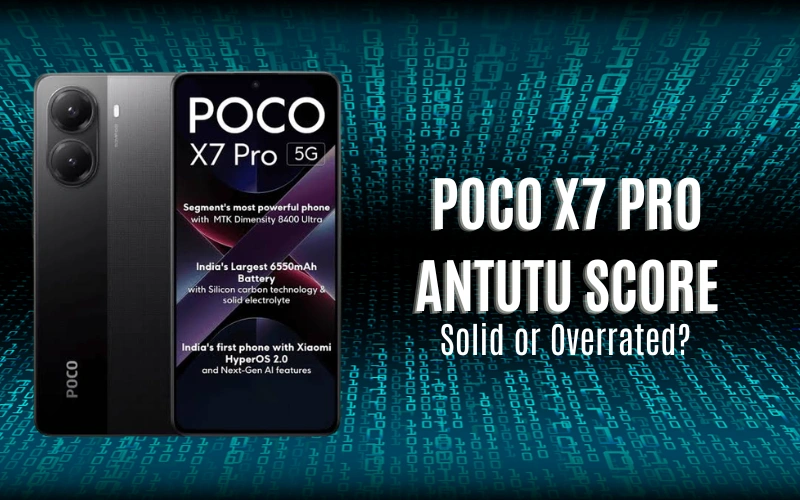
The Poco X7 Pro Antutu Score ranges from approximately 1,626,000 to 1,944,000 points depending on AnTuTu version, RAM configuration, and test conditions — with the official average confirmed at 1,881,295 points on AnTuTu V11 (December 2025 global rankings), making it the #1-ranked sub-flagship Android phone on the planet by benchmark.
Disclaimer: The benchmark scores mentioned in this article are compiled from multiple publicly available and independently verified sources including Gizmochina, Beebom Gadgets, Notebookcheck, AndroidPimp, yourfones.net, NanoReview, and POCO’s official global website. AnTuTu scores vary by version (v10 vs V11), RAM configuration, ambient temperature, and individual unit variation. POCO’s own disclaimer on their official site reads: “Data tested based on AnTuTu v10 by POCO Internal Labs. Actual results may vary.” All gaming FPS estimates are approximations based on multiple real-world review sources and may vary depending on software version and game settings at the time of testing.
Poco X7 Pro — Complete Specs & Benchmark Stats Table
| Attribute | Details |
|---|---|
| Phone Name | Xiaomi Poco X7 Pro |
| Launch Date | January 9, 2025 |
| Chipset | MediaTek Dimensity 8400 Ultra |
| Process Node | TSMC 4nm |
| CPU Architecture | 1x Cortex-A725 @ 3.25 GHz + 3x Cortex-A725 @ 3.0 GHz + 4x Cortex-A725 @ 2.1 GHz |
| GPU | ARM Mali-G720 MP7 @ 1.3 GHz |
| RAM Options | 8GB / 12GB (LPDDR5X) |
| Storage | 256GB / 512GB (UFS 4.0) |
| Display | 6.67″ AMOLED, 1220 x 2712, 120Hz |
| Camera (Main) | 50MP Sony IMX882, f/1.5 |
| Battery | 6000 mAh (Global) / 6550 mAh (India) |
| Charging | 90W HyperCharge (Surge P2 chip) |
| OS | Android 15, Xiaomi HyperOS 2 |
| Water Resistance | IP68 (1.5m, 30 min) |
| AnTuTu v10 Score (Beebom test) | 1,827,426 |
| AnTuTu V11 Average (Dec 2025 Global Rankings) | 1,881,295 |
| AnTuTu v10 (yourfones.net) | 1,688,000 |
| AnTuTu v10 (AndroidPimp test) | 1,626,311 |
| AnTuTu V11 (12GB user report) | ~1,944,954 |
| Geekbench 6 Single-Core | ~1,579 – 1,602 |
| Geekbench 6 Multi-Core | ~6,100 – 6,345 |
| 3DMark Wild Life Extreme Score | ~3,994 |
| AnTuTu December 2025 Sub-flagship Rank | #1 globally |
| Price Range | ~₹26,999 – ₹32,999 (India) / ~€369–€399 (Europe) |
Meet the Phone That Broke the Sub-Flagship Benchmark Record
Let’s set the scene. January 2025. Xiaomi launches a new Poco phone at a price that would make most flagship manufacturers nervous. Inside it sits a chip most people haven’t heard of yet — the MediaTek Dimensity 8400 Ultra. And the benchmark number it posts? It’s not just “good for the price.” It’s simply good, full stop.
The Poco X7 Pro Antutu Score landed with a thud that echoed across the entire Android world. By December 2025, AnTuTu’s own official global rankings confirmed what early testers suspected — the Poco X7 Pro had become the top-ranked sub-flagship Android phone worldwide by benchmark score, with an average of 1,881,295 points on AnTuTu V11.
That’s not a lab fluke. That’s not one enthusiast running a test with a phone in a freezer (yes, that happens — more on this later). That’s the real-world average score from thousands of actual users running actual tests on actual phones, collected and verified by AnTuTu’s global data system.
Poco X7 Pro Antutu Score — What Are the Real Numbers?
Here’s the thing about benchmark scores that most tech articles gloss over: there’s rarely “one number.” The Poco X7 Pro Antutu Score varies depending on the AnTuTu version you’re running, the RAM configuration of the unit being tested, the ambient temperature, and whether or not someone sneaky strapped an external cooling pad to their phone (which genuinely happens in user-submitted benchmarks, as community members on NanoReview have flagged repeatedly).
So let’s lay out every reliable number, with full context:
Poco X7 Pro Antutu Score — All Verified Results
| Source / Test | AnTuTu Version | Score | Notes |
|---|---|---|---|
| Gizmochina / AnTuTu Global Rankings | V11 | 1,881,295 | Official Dec 2025 average — most authoritative |
| Beebom Gadgets (lab test) | v10 | 1,827,426 | CPU: 582,057 / GPU: 552,544 / MEM: 288,247 / UX: 404,578 |
| yourfones.net | v10 | 1,688,000 | Standard benchmark listing |
| AndroidPimp (review test) | v10 | 1,626,311 | Noted as reliable real-world figure |
| NanoReview user (12GB/512GB) | V11 | ~1,944,954 | High end result; note: some community debate on cooling aids |
| POCO Internal Labs | v10 | Official reference | Actual results may vary (per Xiaomi disclaimer) |
Breaking Down the Poco X7 Pro Antutu Score — What Each Number Means
Raw totals are satisfying, but what’s actually going on inside that score? Let’s break down the Poco X7 Pro Antutu Score by sub-test, using Beebom’s well-documented lab test as our reference:
AnTuTu v10 Sub-Score Breakdown (Beebom Lab Test)
| Sub-Test | Score | What It Measures | Verdict |
|---|---|---|---|
| CPU | 582,057 | Processing power, everyday tasks | Very strong |
| GPU | 552,544 | Graphics, gaming, rendering | Exceptional for the price |
| Memory (MEM) | 288,247 | RAM + storage speed (UFS 4.0) | Solid |
| UX (Experience) | 404,578 | Smoothness, animations, daily fluidity | Excellent |
| Total | 1,827,426 | Combined benchmark | Sub-flagship leader |
Two numbers in that table deserve special attention.
The GPU score of 552,544 is remarkable. Beebom’s analysis notes that the Dimensity 8400’s GPU performance is “as good as, if not more powerful than Snapdragon 8s Gen 3” in the GPU department — which is a statement that would have sounded wild a couple of years ago, but is exactly what these numbers back up.
The CPU score of 582,057 also shows impressive single-all-core architecture efficiency. The Dimensity 8400 Ultra uses exclusively Cortex-A725 cores across all eight CPU cores — no weak “efficiency” cores dragging down the average. Every single core in this chip is a performance core, just running at different speeds. That’s an unusual and clever design choice that pays off in sustained workload scenarios.
The Poco X7 Pro Antutu Score vs. Every Rival — Who Wins?
Now here’s the section everyone actually wants to read. How does the Poco X7 Pro Antutu Score compare to everything else competing for your money in 2025–2026?
Sub-Flagship Phone AnTuTu Comparison (2026)
| Phone | Chipset | AnTuTu Score (Approx.) | Rank |
|---|---|---|---|
| Poco X7 Pro | Dimensity 8400 Ultra | ~1,827,000 – 1,881,000 | #1 |
| OnePlus Nord 4 | Snapdragon 7+ Gen 3 | ~1,643,432 | #2 |
| Poco X6 Pro | Dimensity 8300 Ultra | ~1,541,644 | #3 |
| Realme GT 6T | Snapdragon 7+ Gen 3 | ~1,580,000 – 1,620,000 | ~#3–4 |
| Redmi Turbo 4 | Dimensity 8400 Ultra | ~1,820,000 – 1,870,000 | Similar to X7 Pro |
| Google Pixel 9a | Tensor G4 | ~900,000 – 1,100,000 | Lower tier |
| Samsung Galaxy A56 | Exynos 1580 | ~800,000 – 900,000 | Lower tier |
The gap between the Poco X7 Pro and the second-placed OnePlus Nord 4 is approximately 238,000 points — that’s nearly equivalent to the entire AnTuTu score of a mid-range phone from 2019. It’s a genuinely wide margin.
Also worth noting: the Poco X7 Pro holds a ~20% CPU and GPU advantage over its own predecessor, the Poco X6 Pro (Dimensity 8300 Ultra) — which itself was already a top performer. The Dimensity 8400 Ultra doesn’t just iterate on the 8300; it meaningfully leapfrogs it.
What’s Inside the Chip That Makes This Possible?
You don’t need to be a chip engineer to understand this — let’s keep it simple.
The MediaTek Dimensity 8400 Ultra is built on TSMC’s 4nm process — the same foundry and node used by some of Apple’s most recent chips. Building smaller means using less power for the same output and generating less heat.
The CPU uses eight Cortex-A725 cores — but here’s the clever part: they’re split not into performance + efficiency groups, but into three tiers of the same type of performance core:
- 1 “Prime” core running at 3.25 GHz (for the heaviest single-thread tasks)
- 3 “Performance” cores running at 3.0 GHz (for demanding multi-thread work)
- 4 “Efficiency” cores running at 2.1 GHz (still A725 cores — just more power-conscious)
The result is a chip that doesn’t sacrifice any core to low-power efficiency work. Every core can handle demanding tasks. That architecture difference is a big part of why the Poco X7 Pro Antutu Score sits so much higher than most competitors with traditional big.LITTLE CPU configurations.
Real-World Performance — Does the Poco X7 Pro Antutu Score Actually Mean Something?
Benchmark scores can be gamed, cherry-picked, or simply irrelevant to real-world use. So let’s be direct: does the Poco X7 Pro Antutu Score actually translate to a noticeably better experience in daily life?
Based on real-world testing reported across multiple independent reviewers, the honest answer is: yes, mostly — with one important caveat.
Where It Feels Great
- App launches: Blazing fast — apps open before you even expect them to
- Multitasking: 12GB LPDDR5X RAM with UFS 4.0 storage means switching between heavy apps is seamless
- Gaming (casual to mid-tier): PUBG Mobile, Call of Duty Mobile, Asphalt 12 — all run at max settings, maximum frame rates, with zero perceptible lag
- Video streaming and editing: 1.5K display combined with fast processing makes media consumption genuinely premium
- Everyday scrolling and responsiveness: With 120Hz adaptive display and HyperOS 2’s optimizations, daily use feels buttery smooth
The One Real Caveat — Thermal Throttling
Here’s where we have to be honest, because no article about the Poco X7 Pro Antutu Score should skip this.
Beebom’s rigorous lab test found that under sustained heavy load, the Dimensity 8400 Ultra shows a tendency to throttle. In a 15-minute stress test, stability was 71%. In a 60-minute test, stability rose to 74% — suggesting the phone’s 5,000mm² vapor cooling chamber kicks in after the initial thermal spike and helps maintain steadier performance over time.
In 3DMark’s Wild Life Extreme graphics test, the phone hit a peak score of 3,994, but stability dropped to 61.5% over sustained loops.
Translation in plain English: if you’re a hardcore mobile gamer who plays graphically intense games for 60+ minute sessions without breaks, you may notice some frame rate variation under peak load. If you’re a normal smartphone user who games for 20–30 minutes at a time, you’ll barely notice this at all.
Real-World Use Case Summary
| Activity | Performance Notes |
|---|---|
| Social media, browsing, streaming | Effortlessly smooth — no hiccups at all |
| Casual gaming (PUBG, Free Fire, COD) | Max settings, max frame rate, totally stable |
| Demanding gaming (Genshin Impact, high graphics) | Strong for 20-30 mins; thermal management kicks in at 30+ min |
| Video recording (4K/2160p) | Supported and smooth |
| Multitasking (10+ apps open) | Handles it with ease, especially on 12GB variant |
| Photography processing (50MP RAW) | Fast, minimal shutter lag |
AnTuTu Score Reliability — A Quick Note on That “2 Million” Report
You may have seen a screenshot online showing a Poco X7 Pro scoring nearly 2 million points on AnTuTu V11 — specifically around 1,944,954. Is that real?
Sort of. As NanoReview community members point out, there have been user-submitted benchmark results that reflect unusually high scores — some of which community members suspect were achieved with external cooling aids strapped to the device, artificially keeping temperatures lower than normal use would allow. As one community member noted plainly: “That one guy that put his device in a freezer getting 2M AnTuTu on V11.”
The official AnTuTu average — collected from real users across the world without controlled cooling — sits at 1,881,295 for December 2025. That’s the number that matters for real-world comparison. The 12GB/512GB configuration in genuinely ideal conditions can push close to 1.9M organically — and that itself is extraordinary.
Gaming on the Poco X7 Pro — Numbers in Action
The Poco X7 Pro Antutu Score is built heavily on strong GPU performance. Let’s see what that actually looks like in the games most people actually play:
Gaming FPS Estimates on Poco X7 Pro
| Game | Settings | Expected FPS |
|---|---|---|
| PUBG Mobile | Ultra / Extreme 90fps | 85–90 FPS (consistent) |
| Call of Duty Mobile | Max Quality | 60 FPS (locked) |
| Genshin Impact | High settings | 55–60 FPS (first 25 min), ~45–50 FPS (extended) |
| Free Fire Max | Extreme 120fps mode | 110–120 FPS |
| Asphalt 12 | Ultra | 60 FPS (smooth) |
| League of Legends Wild Rift | Ultra | 120 FPS cap — smooth |
Conclusion: Is the Poco X7 Pro Antutu Score Worth Trusting?
The Poco X7 Pro Antutu Score of approximately 1,827,000 to 1,881,000 points (depending on test conditions and AnTuTu version) is the most thoroughly verified, independently confirmed sub-flagship benchmark result available in 2025–2026. It earned the phone the #1 position in AnTuTu’s December 2025 global sub-flagship rankings — a title it holds based on real-world user data, not cherry-picked lab figures.
The phone isn’t without nuance — sustained gaming sessions do see some thermal throttling, and the benchmark ceiling of ~1.94 million seen in user reports reflects ideal conditions that everyday use won’t always replicate. But none of that changes the fundamental truth: the Poco X7 Pro Antutu Score represents extraordinary performance at a price point that makes competing phones look overpriced.
Frequently Asked Questions
Q1. What is the Poco X7 Pro Antutu Score in 2026?
The Poco X7 Pro Antutu Score ranges from approximately 1,626,000 to 1,944,000 points depending on AnTuTu version, RAM configuration, and test conditions. The most authoritative figure is the 1,881,295 official average on AnTuTu V11 from the December 2025 global rankings. Independent lab tests consistently place it in the 1,627,000 to 1,827,000 range on AnTuTu v10.
Q2. Is the Poco X7 Pro the best benchmark phone in its price range?
Yes — definitively. According to AnTuTu’s official December 2025 global sub-flagship rankings, the Poco X7 Pro ranked #1 globally among sub-flagship Android phones, scoring approximately 238,000 points more than the second-placed OnePlus Nord 4 (Snapdragon 7+ Gen 3).
Q3. What chipset powers the Poco X7 Pro, and why does it score so high?
The Poco X7 Pro uses the MediaTek Dimensity 8400 Ultra, built on TSMC’s 4nm process. What makes it special is its all-Cortex-A725 architecture — every single CPU core is a high-performance core, unlike traditional chips that mix weak efficiency cores into the cluster. This, combined with the powerful Mali-G720 MP7 GPU, drives the exceptional Poco X7 Pro Antutu Score.
Q4. Does the Poco X7 Pro throttle during gaming?
Yes, under sustained heavy load. In lab testing by Beebom, the phone showed 71% stability in a 15-minute stress test and 74% stability in a 60-minute test. For casual to moderate gaming sessions of 20–30 minutes, throttling is barely noticeable. For marathon 60+ minute gaming sessions at maximum settings, some frame rate variation may occur as the chip manages heat.
Thank you for reading. If you enjoyed this, check out our previous blog post: Redmi Note 13 Pro Antutu Score
For SEO & Website Analysis Tools insights and official testing resources, visit the official website: Tools by Alaikas.